Research Highlights Strength of Cuyahoga County's Arts Ecosystem
New Research Highlights Strength of Cuyahoga County's Arts Ecosystem and Explores Long-Term Public Funding Models
CLEVELAND | July 21, 2026 — Assembly for the Arts recently announced the release of Research on Public Funding of the Arts to Inform Cuyahoga County, a new study examining how arts and culture are funded in peer communities across the country and what those approaches may reveal about sustainable long-term cultural investment.
Conducted by SMU DataArts and Lord Cultural Resources, the research compares Cuyahoga County with peer communities across the region and nation to surface patterns, challenges, and considerations for future discussion.
The report comes on the heels of the recently released City Arts Sector Trends: Divergence and Resilience Across Ten U.S. Cities (2019–2024) from SMU DataArts, which identified Cleveland as one of the more resilient arts ecosystems among the ten cities studied. Together, the reports suggest that Cleveland’s strong foundation of local arts investment has helped support a vibrant cultural sector, while underscoring the importance of long-term planning to sustain that success.
The study of funding models finds that Cuyahoga County enters this moment with significant strengths, including a vibrant arts ecosystem, strong individual giving, and a nationally recognized public funding model through the county’s dedicated cigarette tax. The research identifies projected declines in revenue from the tax as well as rising costs for local arts organizations that are outpacing contributed revenue as potential risks for the sector.
“Cuyahoga County’s arts and culture community is one of Greater Cleveland’s greatest strengths,” said Jeremy Johnson, president and CEO of Assembly for the Arts. “This research confirms what many in our community already know: Cuyahoga County has built a remarkable arts ecosystem supported by strong public and private investment. At the same time, it gives us valuable information to help inform future conversations about how we can continue to sustain and strengthen that success for generations to come.”
Among the report’s findings is that the most resilient funding systems often layer multiple sources of support rather than relying on a single mechanism. Looking across peer communities, the research surfaces two ideas worth further exploration in future conversations about arts funding:
- Revenue diversification. Dedicated funding mechanisms tied to economic activity may provide more durable revenue capacity over time than fixed-rate approaches alone.
- Regional collaboration. Multi-jurisdiction approaches can help build broader coalitions of support and create greater resilience against shifts in funding priorities or economic conditions.
Researchers reviewed funding approaches in 15 communities nationwide and conducted deeper examinations of funding systems in Columbus, Denver, Minneapolis, Pittsburgh, and Portland. The review identified five primary funding approaches currently in use across the country:
- Hotel-motel or transient occupancy taxes
- General fund appropriations
- Privately led funding models
- Dedicated arts taxes
- Collaborative or hybrid public-private models
The research found that no single funding mechanism dominates nationally. Instead, many communities combine multiple approaches to balance stability, flexibility, and scale.
The study was commissioned by Assembly for the Arts with support from The Cleveland Foundation, The George Gund Foundation, the Paul M. Angell Family Foundation, and Cuyahoga County. Research was conducted by SMU DataArts and Lord Cultural Resources.
The full report is available at https://assemblycle.org/arts-funding-future/.
###
About Assembly for the Arts
Assembly for the Arts is a 501(c)(3) nonprofit dedicated to strengthening and advancing Greater Cleveland’s arts and culture sector. The organization champions advocacy, cultural policy, racial equity, research, and regional promotion, while providing essential services and resources to nonprofits, artists, and creative businesses. Assembly serves the entire creative sector, working in tandem with Assembly for Action, a 501(c)(4) political action nonprofit, to champion public and private investments that unify Greater Cleveland’s arts and culture industry. Learn more at https://assemblycle.org.
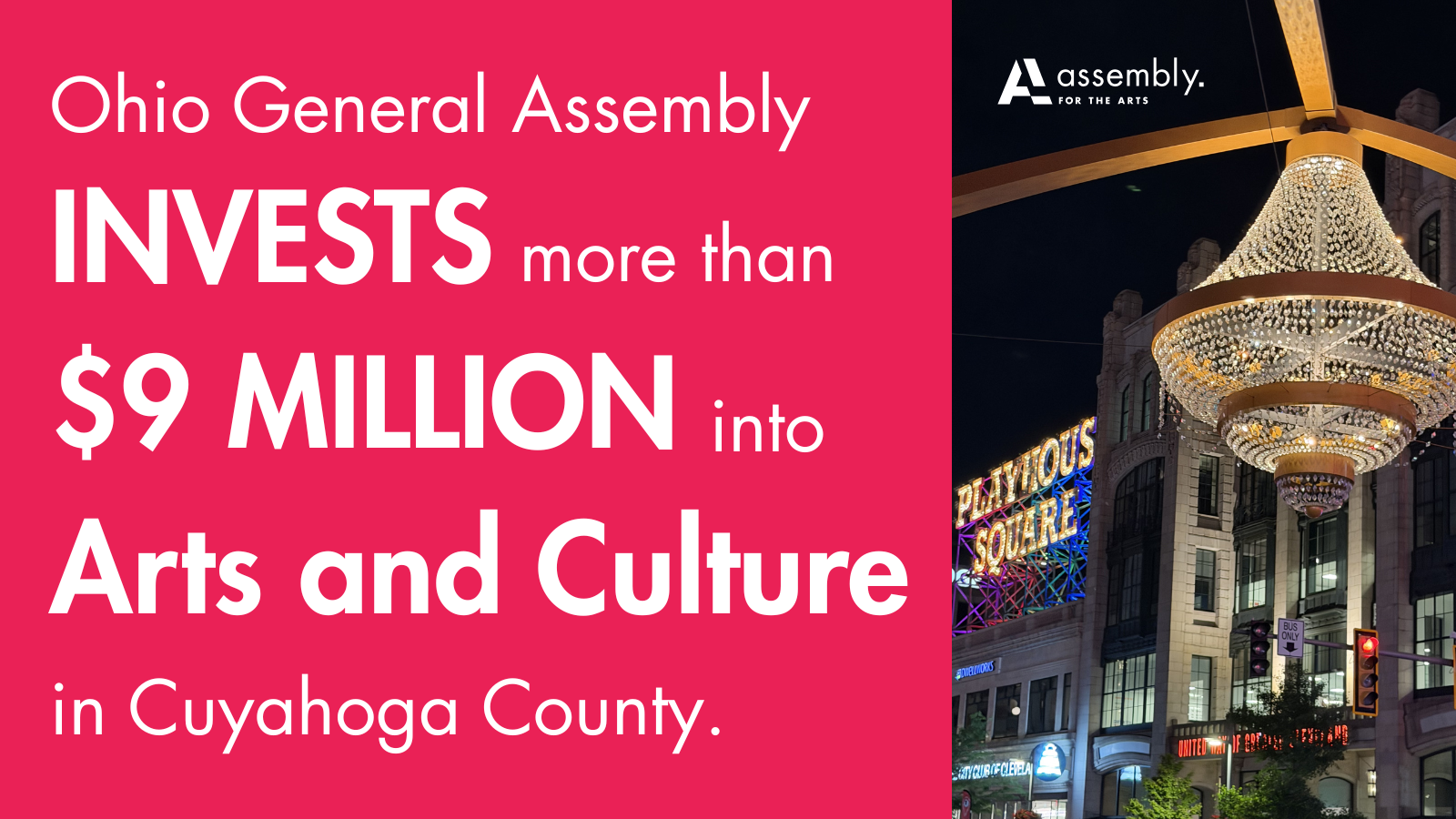
Ohio General Assembly Invests More Than $9 Million in Arts and Culture Organizations in Cuyahoga County
Ohio General Assembly Invests More Than $9 Million in Arts and Culture Organizations in Cuyahoga County
CLEVELAND, OH | July 14, 2026 — More than $9 million has been allocated to 24 arts, culture, and heritage projects across Cuyahoga County through Ohio’s recently enacted biennial capital budget (SB 450), marking a major investment in the region’s creative economy and community infrastructure.
According to Assembly for the Arts, cultural, arts, and heritage projects received more than $9 million of the approximately $37 million in total state capital funding awarded in Cuyahoga County—nearly 25% of all county allocations. The funding will support critical facility improvements, renovations, and public space enhancements that strengthen communities and expand access to arts and cultural experiences throughout Northeast Ohio.
“This is a transformational moment for our region,” said Jeremy Johnson, President and CEO of Assembly for the Arts. “The state legislature and Governor DeWine have sent a clear message that investing in the arts is investing in community resilience and economic vitality. From our legacy institutions to our neighborhood anchors, this funding ensures that our creative spaces can safely and effectively serve future generations.”
Funded projects span the county, supporting both nationally recognized cultural institutions and neighborhood-based community organizations. Investments include infrastructure improvements at the Cleveland Museum of Art and Playhouse Square, as well as enhancements for community-centered organizations such as Near West Theatre, Dobama Theatre, and Beck Center for the Arts.
The capital budget also supports key place-making and public space initiatives, including improvements to University Circle’s Wade Oval and the Irishtown Bend Park Heritage Site, helping strengthen the cultural and civic assets that contribute to the region’s quality of life and economic growth.
A full list of funded capital projects in Cuyahoga County is available through the Ohio Legislative Service Commission: Capital Projects by County (SB 450).
###
About Assembly for the Arts
Assembly for the Arts is a 501(c)(3) nonprofit organization with a focus on advocacy, cultural policy, racial equity initiatives, research, marketing that elevates the region, and services for nonprofits, artists, and creative businesses. It is governed by a volunteer board with a strong commitment to diversity and inclusion. Assembly serves the entire creative sector, working in tandem with Assembly for Action, a 501(c)(4) political action nonprofit, to champion public and private investments that unify Greater Cleveland’s arts and culture industry.
The Future of Arts Funding in Cuyahoga County
The Future of Arts Funding in Cuyahoga County
New research from Assembly for the Arts, SMU DataArts, and Lord Cultural Resources examines the current state of arts funding in Cuyahoga County, analyzes peer funding models from across the country, and explores opportunities for long-term resilience.
Key Takeaways
Explore the main takeaways of the report.
Read the Report
Click on the button below to access the full data report.
Why This Report Matters
The arts and culture sector is a vital contributor to quality of life, economic activity, and community vitality. Yet arts organizations are navigating rising costs, shifting revenue streams, and increasing competition for philanthropic and public funding.
While Cuyahoga County remains a national leader in public arts support, the region’s primary public funding source—a dedicated cigarette tax—faces long-term challenges as smoking rates continue to decline. This report explores how communities across the country are funding arts and culture and what lessons may help inform future conversations about cultural investment in Greater Cleveland.
In this report, you will discover:
How five U.S. regions fund arts and culture through different public revenue models.
The tradeoffs between stability, flexibility, and equity across funding systems.
The role of government, nonprofits, and cultural institutions in administering public funds.
Key lessons and considerations for communities evaluating future cultural funding strategies.
Five Key Takeaways
Cuyahoga Is Among the Nation's Most Arts-Vibrant Communities
The county consistently ranks among the top arts ecosystems in the United States, supported by strong public and private investment.
Rising Costs Are Creating Pressure
Expenses increased 21% between 2022 and 2023 while contributed income declined.
Public Funding Creates Stability
Organizations receiving local public funding outperform non-funded peers in attendance recovery and earned revenue generation.

Strong Systems Layer Revenue Sources
Research from peer regions suggests that communities with multiple funding streams are often better positioned to weather economic and political change.
Dedicated Funding Works—But Has Limits
The cigarette tax has provided exceptional stability, but revenues have declined 34% since 2016 due to reduced cigarette consumption.
Dive Deeper into the Data
These findings are just the beginning. Explore detailed case studies, funding structures, governance models, equity approaches, and operational insights from Denver, Pittsburgh, Portland, Minneapolis, and Columbus.
Five Cities. Five Approaches to Public Arts Funding.
There is no one-size-fits-all approach to arts funding. The report examines five communities that have built distinct funding systems based on their local priorities, governance structures, and economic conditions.
Denver
Regional Sales Tax
A voter-approved regional sales tax provides long-term, dedicated funding for cultural and scientific organizations across seven counties.
Pittsburgh
County Sales Tax
A permanent countywide sales tax funds cultural institutions, libraries, parks, and other regional assets through a statutory allocation system.
Portland
Arts Income Tax
A flat annual arts tax supports arts education and cultural programming, with funding priorities established through city code.
Minneapolis
General Fund Support
Arts funding is primarily allocated through the city’s annual budget process, making support directly tied to municipal fiscal conditions.
Columbus
Admissions & Tourism Taxes
Revenue from entertainment admissions and hotel stays helps fund grants, artists, festivals, and cultural organizations citywide.
What We Learned from Peer Communities
Layer Funding Sources
The most resilient systems combine multiple revenue streams.
Design for Equity
Funding outcomes are shaped by structural design, not just grant guidelines.
Think Regionally
Regional approaches can strengthen political support and financial sustainability.
Build for the Long Term
Dedicated funding mechanisms work best when designed to adapt to changing economic conditions.
Strength Today. Resilience Tomorrow.
Cuyahoga County enters this moment from a position of strength. It ranks among the nation’s most arts-vibrant communities, leads peer regions in individual giving, and benefits from one of the country’s most recognized public arts funding mechanisms.
Yet the most durable arts funding systems are those that continuously evolve alongside changing economic conditions, community needs, and funding landscapes. Through analysis of local trends and peer communities across the country, this report explores how funding structures can support both stability and adaptability over the long term.
The opportunity ahead is clear: build on a successful foundation while planning for the future.
Explore the Broader Conversation
Discover additional research, stories, and resources examining arts funding, cultural policy, community impact, and the future of Greater Cleveland’s creative sector.

Northeast Ohio’s Cultural Future: What Cities Can Teach Us About Cultural Investment
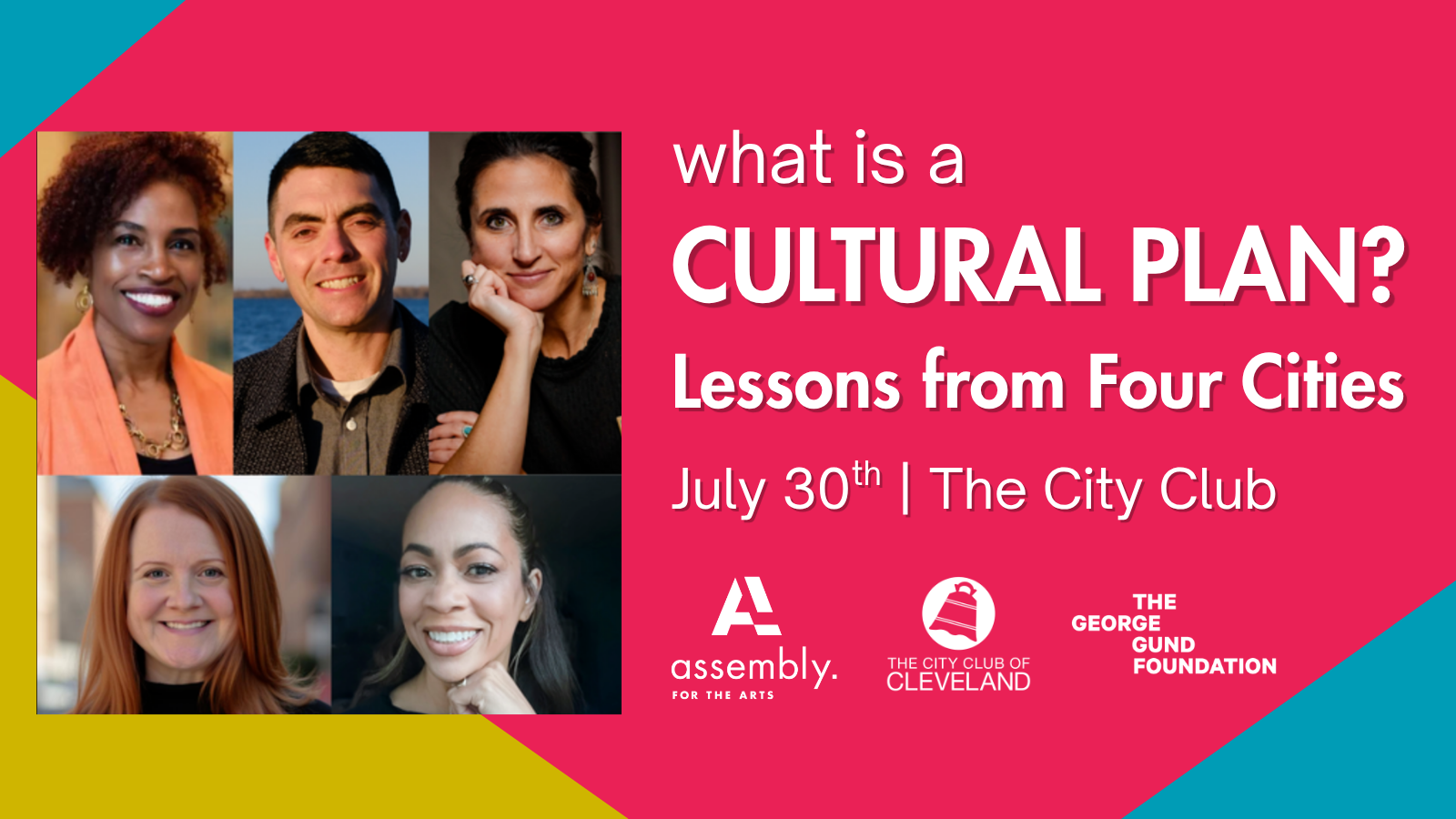

Analysis of Cultural Sectors Across 10 U.S. Cities Reveals Divergence in Financial Health Since Pandemic
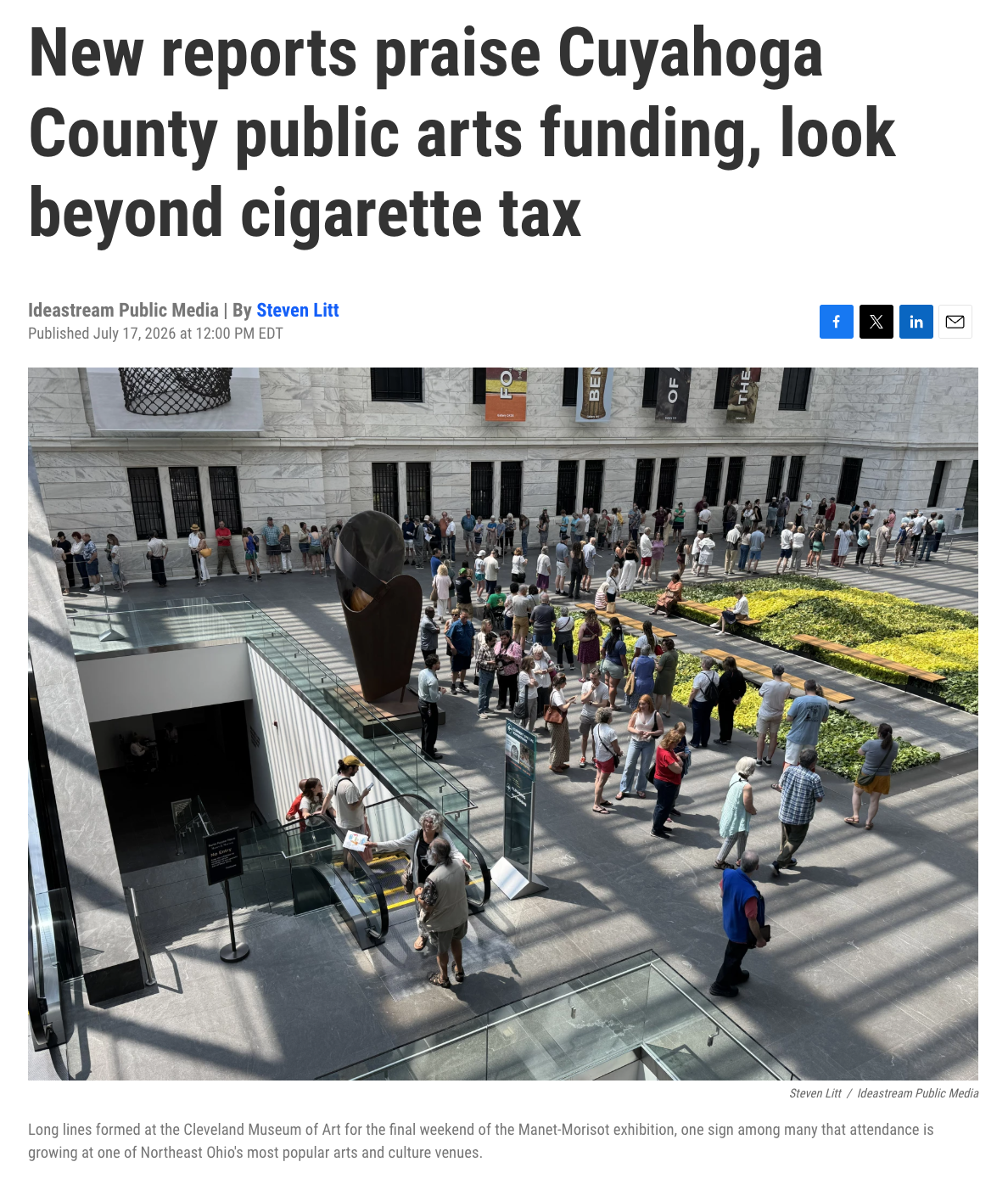
Ideastream: New reports praise Cuyahoga County public arts funding, look beyond cigarette tax
Stay Connected
Interested in future research, data insights, and conversations about arts and culture in Cuyahoga County?

Acknowledgements
This research was made possible through the generous support of the funders below who recognized the importance of this work for Cuyahoga County.

This research was commissioned by Assembly for the Arts and made completed through a partnership with SMU DataArts and Lord Cultural Resources.


What is a Cultural Plan? Lessons from Four Cities
What is a Cultural Plan? Lessons from Four Cities
Thursday, July 30, 2026
11:30 a.m. - 1:00 p.m.
Doors at 11:15am / Lunch at 11:30am / Forum begins 12:00pm
The City Club of Cleveland
1317 Euclid Avenue, Suite 100 Cleveland, OH 44115
Across the country, communities are increasingly turning to cultural planning to support and grow their creative economies. Whether a city is actively drafting its first vision or beginning to activate it, the process requires constant adaptation, collaboration, and shared learning.
This forum explores the practical tradeoffs, constraints, and successes of shaping local culture at every stage of development. Featured arts leaders will share insights from peer communities on how these ongoing planning efforts play out amid civic and economic realities—offering an open space to learn from peer communities, ask questions, and deepen shared understanding about what cultural planning can look like in practice, while reflecting on Cleveland’s evolving cultural landscape.
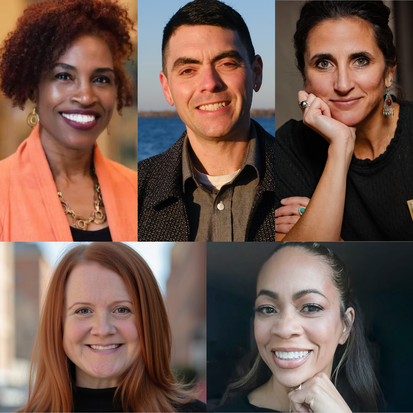
Meet the Panelists
This session will be moderated by Jennifer Coleman, Program Director of Creative Culture and Art at The George Gund Foundation.

Patrick Fisher

Valerie V. Gay

Mary McNamara Bernsten
Nicole Mullet
FAQ
Frequently Asked Questions
This forum is presented by a partnership between Assembly for the Arts, the City Club of Cleveland, and The Gund Foundation. Assembly for the Arts was awarded a grant from The Gund Foundation to organize and assemble this discussion. The panel and luncheon event will be hosted by our friends at The City Club of Cleveland.
Yes, a ticket is required. Tickets can be purchased via The City Club here.
City Club Member Ticket Cost: $30
Non-Member Ticket Cost: $45
Online ticket sales for this forum will conclude on Tuesday, July 28th at 11:30am.
The event will be livestreamed for free. Virtual attendees can still participate in the event’s Q&A portion via The City Club’s messaging platform (details will be provided during the forum). Those who are interested in receiving a reminder before the event goes live can sign up here.
For those unable to attend or who would like to revisit the event, the panel discussion will be available via a recording after the live event.
The idea for this City Club event originated in June 2025 when Jeremy Johnson and Jennifer Coleman attended the Americans for the Arts Annual Convention in Cincinnati. During the conference, they attended a presentation by Rockford, Illinois, on the city’s recent cultural planning process and were impressed by the work being done there. Representatives from Philadelphia were also in attendance, and after the session, Jeremy and Jennifer engaged them in a lengthy conversation about Philadelphia’s own cultural planning efforts.
Inspired by these discussions, they felt it would be valuable to bring these communities to Cleveland to share their experiences and lessons learned. Akron was invited because of its proximity and because, despite being a smaller city than Cleveland, it has made remarkable progress in implementing its cultural plan. Pittsburgh was included as well, given its similarities to Cleveland in terms of size, history, and regional context, offering another relevant perspective on cultural planning and execution.
For Assembly, the past year has been a powerful period of deep research and national data gathering. This summer, we are proud to transition into a phase of broad civic collaboration. We’re sharing our findings to catalyze new ideas alongside artists, arts organizations, philanthropy, and public partners.
For example, we just completed a comparative study with SMU DataArts on national public funding models (which will be published on this website). Bringing in leaders from other cities allows us to build directly on that momentum. We’re looking at real-world examples of how peer communities navigate advocacy, funding, politics, artist empowerment, and economic development.
The City of Cleveland is a valued stakeholder and vital partner in conversations surrounding the future of our creative economy. However, this panel was independently conceived by Assembly to serve as an open, collaborative civic space building on our capacity as a convener and researcher.
That said, we are delighted that many partners, including representatives from the City of Cleveland, local artists, and philanthropists, are at the table as we explore insights from sister cities that might be relevant to our cultural landscape.
At its core, this is a learning panel and a vehicle for civic exploration. Having previously led a comprehensive cultural planning process in Newark, New Jersey (Newark Creates), Assembly’s President and CEO Jeremy Johnson recognizes the immense practical value of asking peer cities to share their direct experiences.
This forum brings together diverse sectors—artists, creative businesses, public officials, and philanthropists—to deepen our collective understanding, recognize what is working across the country, and anticipate challenges and opportunities ahead.
Presented by