Research Highlights Strength of Cuyahoga County's Arts Ecosystem
New Research Highlights Strength of Cuyahoga County's Arts Ecosystem and Explores Long-Term Public Funding Models
CLEVELAND | July 21, 2026 — Assembly for the Arts recently announced the release of Research on Public Funding of the Arts to Inform Cuyahoga County, a new study examining how arts and culture are funded in peer communities across the country and what those approaches may reveal about sustainable long-term cultural investment.
Conducted by SMU DataArts and Lord Cultural Resources, the research compares Cuyahoga County with peer communities across the region and nation to surface patterns, challenges, and considerations for future discussion.
The report comes on the heels of the recently released City Arts Sector Trends: Divergence and Resilience Across Ten U.S. Cities (2019–2024) from SMU DataArts, which identified Cleveland as one of the more resilient arts ecosystems among the ten cities studied. Together, the reports suggest that Cleveland’s strong foundation of local arts investment has helped support a vibrant cultural sector, while underscoring the importance of long-term planning to sustain that success.
The study of funding models finds that Cuyahoga County enters this moment with significant strengths, including a vibrant arts ecosystem, strong individual giving, and a nationally recognized public funding model through the county’s dedicated cigarette tax. The research identifies projected declines in revenue from the tax as well as rising costs for local arts organizations that are outpacing contributed revenue as potential risks for the sector.
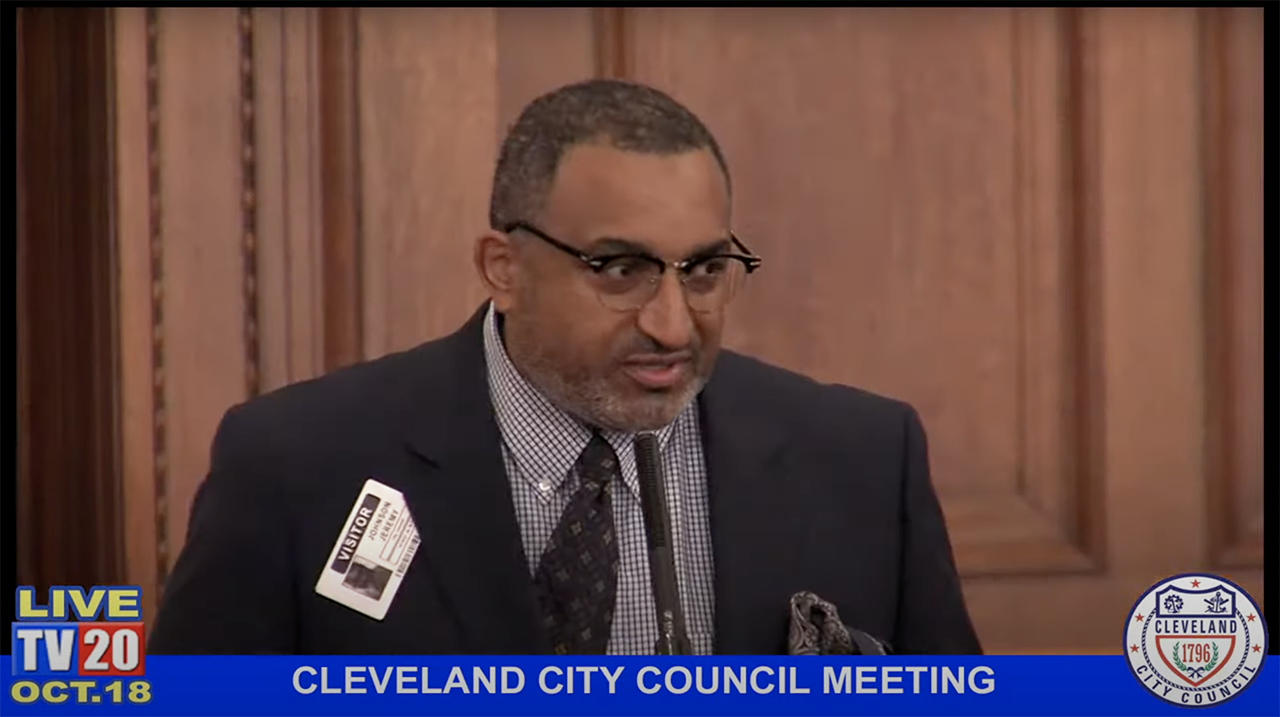
“Cuyahoga County’s arts and culture community is one of Greater Cleveland’s greatest strengths,” said Jeremy Johnson, president and CEO of Assembly for the Arts. “This research confirms what many in our community already know: Cuyahoga County has built a remarkable arts ecosystem supported by strong public and private investment. At the same time, it gives us valuable information to help inform future conversations about how we can continue to sustain and strengthen that success for generations to come.”
Among the report’s findings is that the most resilient funding systems often layer multiple sources of support rather than relying on a single mechanism. Looking across peer communities, the research surfaces two ideas worth further exploration in future conversations about arts funding:
- Revenue diversification. Dedicated funding mechanisms tied to economic activity may provide more durable revenue capacity over time than fixed-rate approaches alone.
- Regional collaboration. Multi-jurisdiction approaches can help build broader coalitions of support and create greater resilience against shifts in funding priorities or economic conditions.
Researchers reviewed funding approaches in 15 communities nationwide and conducted deeper examinations of funding systems in Columbus, Denver, Minneapolis, Pittsburgh, and Portland. The review identified five primary funding approaches currently in use across the country:
- Hotel-motel or transient occupancy taxes
- General fund appropriations
- Privately led funding models
- Dedicated arts taxes
- Collaborative or hybrid public-private models
The research found that no single funding mechanism dominates nationally. Instead, many communities combine multiple approaches to balance stability, flexibility, and scale.
The study was commissioned by Assembly for the Arts with support from The Cleveland Foundation, The George Gund Foundation, the Paul M. Angell Family Foundation, and Cuyahoga County. Research was conducted by SMU DataArts and Lord Cultural Resources.
The full report is available at https://assemblycle.org/arts-funding-future/.
###
About Assembly for the Arts
Assembly for the Arts is a 501(c)(3) nonprofit dedicated to strengthening and advancing Greater Cleveland’s arts and culture sector. The organization champions advocacy, cultural policy, racial equity, research, and regional promotion, while providing essential services and resources to nonprofits, artists, and creative businesses. Assembly serves the entire creative sector, working in tandem with Assembly for Action, a 501(c)(4) political action nonprofit, to champion public and private investments that unify Greater Cleveland’s arts and culture industry. Learn more at https://assemblycle.org.
The Future of Arts Funding in Cuyahoga County
The Future of Arts Funding in Cuyahoga County
New research from Assembly for the Arts, SMU DataArts, and Lord Cultural Resources examines the current state of arts funding in Cuyahoga County, analyzes peer funding models from across the country, and explores opportunities for long-term resilience.
Key Takeaways
Explore the main takeaways of the report.
Read the Report
Click on the button below to access the full data report.
Why This Report Matters
The arts and culture sector is a vital contributor to quality of life, economic activity, and community vitality. Yet arts organizations are navigating rising costs, shifting revenue streams, and increasing competition for philanthropic and public funding.
While Cuyahoga County remains a national leader in public arts support, the region’s primary public funding source—a dedicated cigarette tax—faces long-term challenges as smoking rates continue to decline. This report explores how communities across the country are funding arts and culture and what lessons may help inform future conversations about cultural investment in Greater Cleveland.
In this report, you will discover:
How five U.S. regions fund arts and culture through different public revenue models.
The tradeoffs between stability, flexibility, and equity across funding systems.
The role of government, nonprofits, and cultural institutions in administering public funds.
Key lessons and considerations for communities evaluating future cultural funding strategies.
Five Key Takeaways
Cuyahoga Is Among the Nation's Most Arts-Vibrant Communities
The county consistently ranks among the top arts ecosystems in the United States, supported by strong public and private investment.
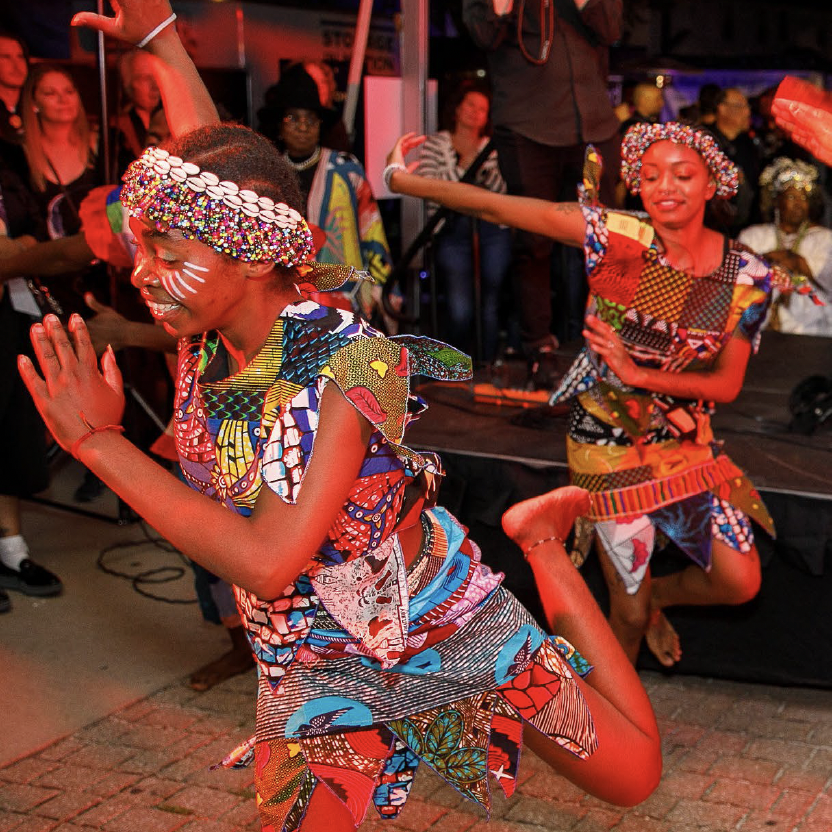
Rising Costs Are Creating Pressure
Expenses increased 21% between 2022 and 2023 while contributed income declined.
Public Funding Creates Stability
Organizations receiving local public funding outperform non-funded peers in attendance recovery and earned revenue generation.

Strong Systems Layer Revenue Sources
Research from peer regions suggests that communities with multiple funding streams are often better positioned to weather economic and political change.
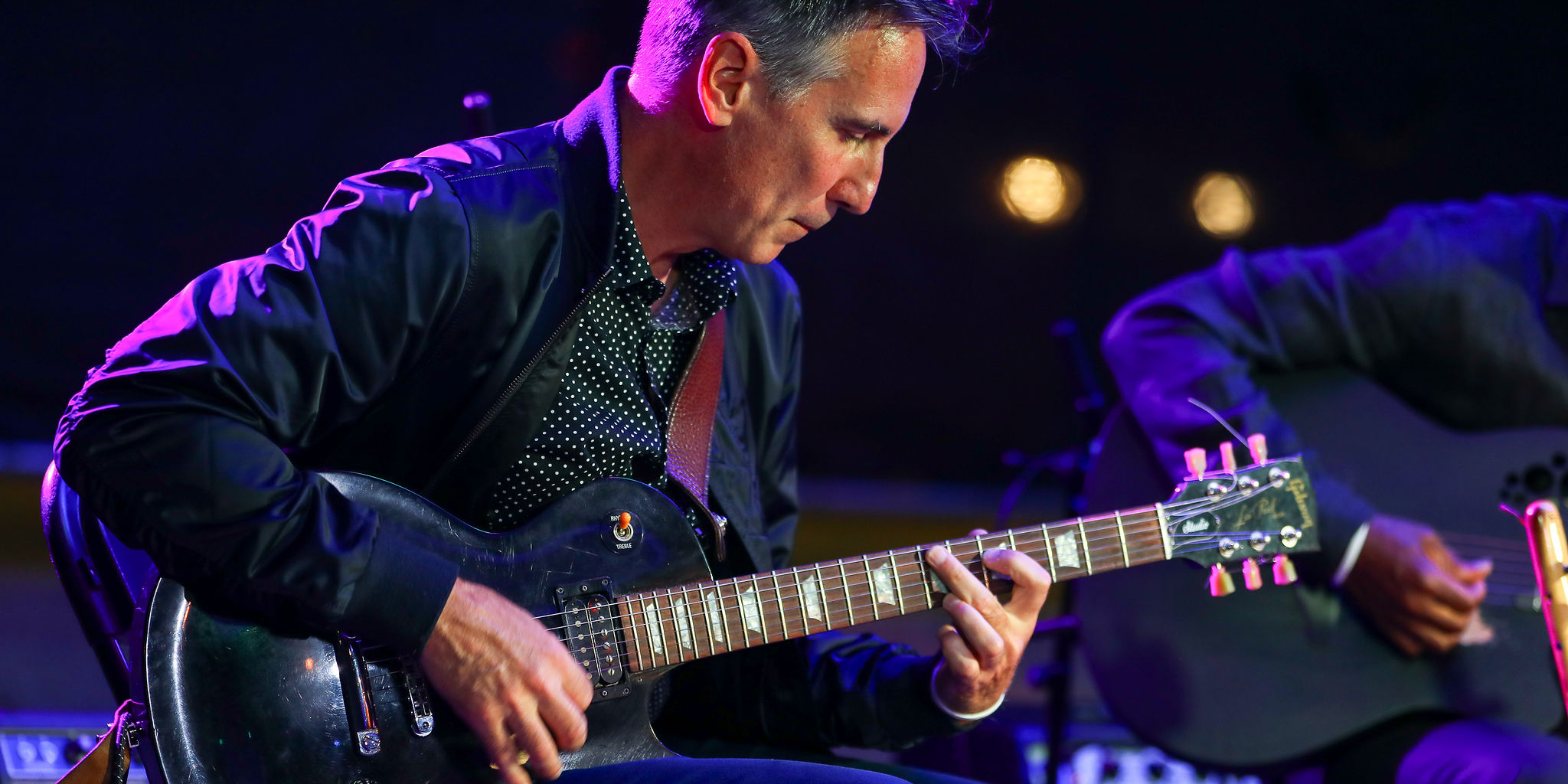
Dedicated Funding Works—But Has Limits
The cigarette tax has provided exceptional stability, but revenues have declined 34% since 2016 due to reduced cigarette consumption.
Dive Deeper into the Data
These findings are just the beginning. Explore detailed case studies, funding structures, governance models, equity approaches, and operational insights from Denver, Pittsburgh, Portland, Minneapolis, and Columbus.
Five Cities. Five Approaches to Public Arts Funding.
There is no one-size-fits-all approach to arts funding. The report examines five communities that have built distinct funding systems based on their local priorities, governance structures, and economic conditions.
Denver
Regional Sales Tax
A voter-approved regional sales tax provides long-term, dedicated funding for cultural and scientific organizations across seven counties.
Pittsburgh
County Sales Tax
A permanent countywide sales tax funds cultural institutions, libraries, parks, and other regional assets through a statutory allocation system.
Portland
Arts Income Tax
A flat annual arts tax supports arts education and cultural programming, with funding priorities established through city code.
Minneapolis
General Fund Support
Arts funding is primarily allocated through the city’s annual budget process, making support directly tied to municipal fiscal conditions.
Columbus
Admissions & Tourism Taxes
Revenue from entertainment admissions and hotel stays helps fund grants, artists, festivals, and cultural organizations citywide.
What We Learned from Peer Communities
Layer Funding Sources
The most resilient systems combine multiple revenue streams.
Design for Equity
Funding outcomes are shaped by structural design, not just grant guidelines.
Think Regionally
Regional approaches can strengthen political support and financial sustainability.
Build for the Long Term
Dedicated funding mechanisms work best when designed to adapt to changing economic conditions.
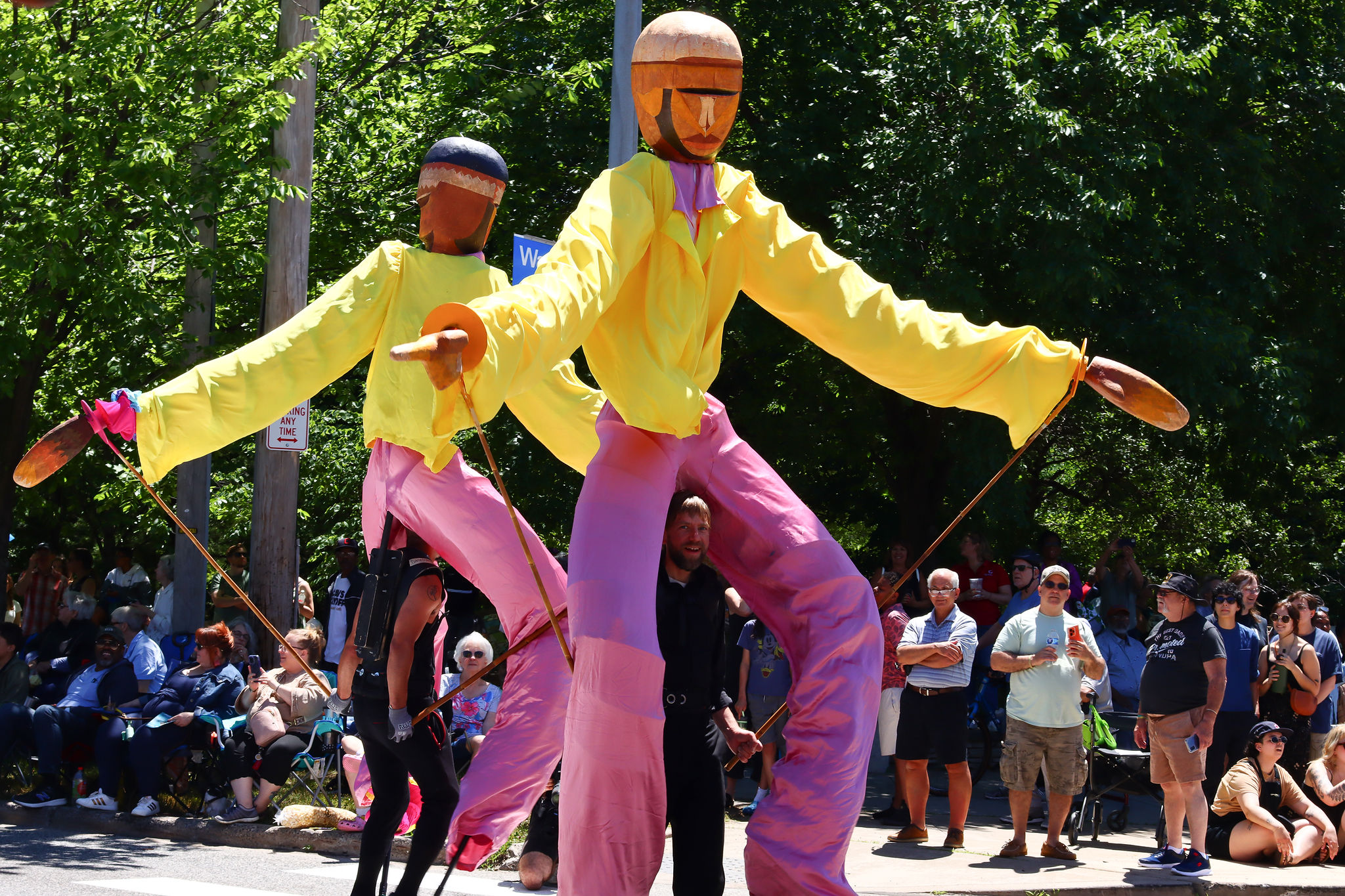
Strength Today. Resilience Tomorrow.
Cuyahoga County enters this moment from a position of strength. It ranks among the nation’s most arts-vibrant communities, leads peer regions in individual giving, and benefits from one of the country’s most recognized public arts funding mechanisms.
Yet the most durable arts funding systems are those that continuously evolve alongside changing economic conditions, community needs, and funding landscapes. Through analysis of local trends and peer communities across the country, this report explores how funding structures can support both stability and adaptability over the long term.
The opportunity ahead is clear: build on a successful foundation while planning for the future.
Explore the Broader Conversation
Discover additional research, stories, and resources examining arts funding, cultural policy, community impact, and the future of Greater Cleveland’s creative sector.

Northeast Ohio’s Cultural Future: What Cities Can Teach Us About Cultural Investment
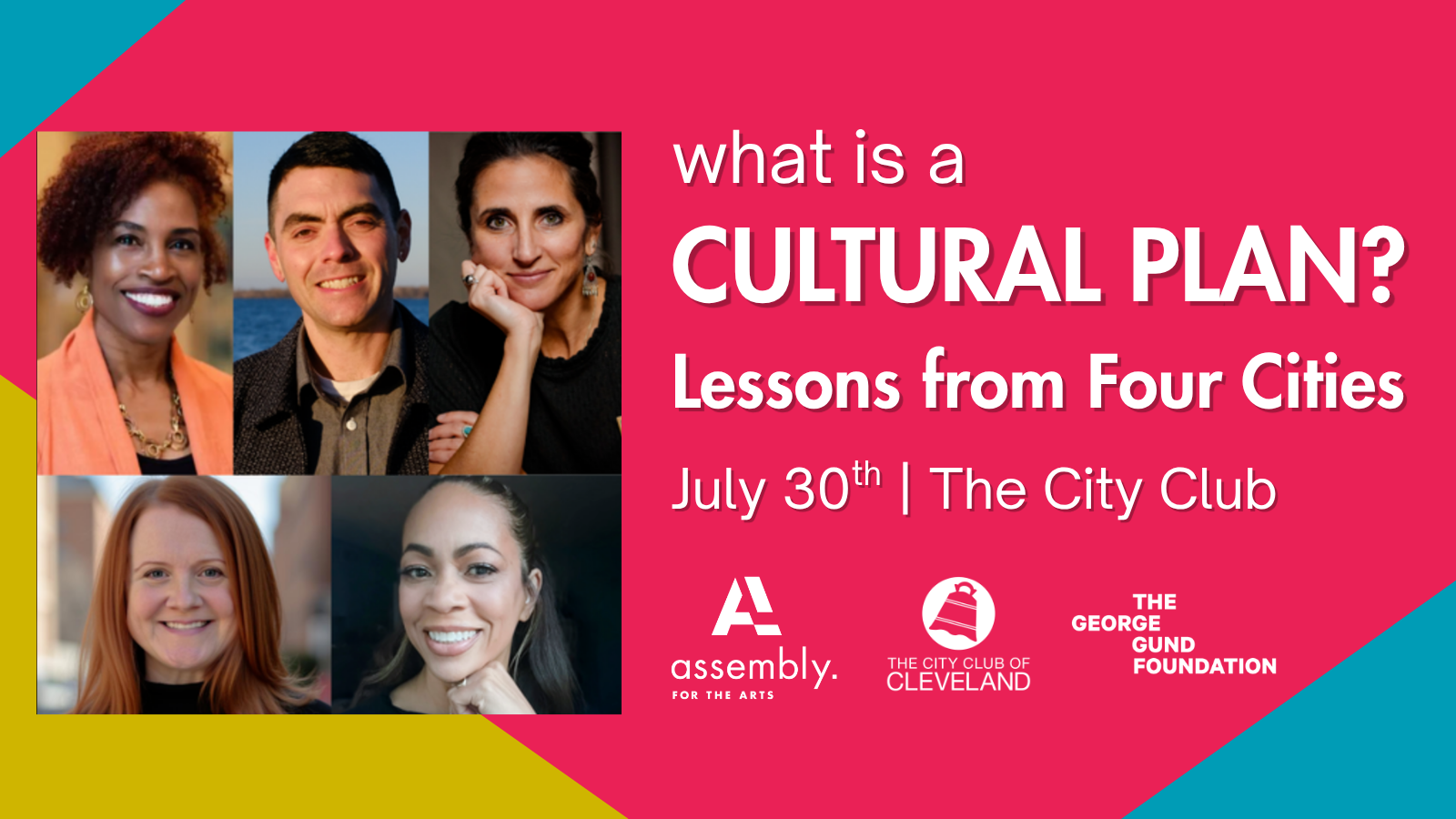

Analysis of Cultural Sectors Across 10 U.S. Cities Reveals Divergence in Financial Health Since Pandemic
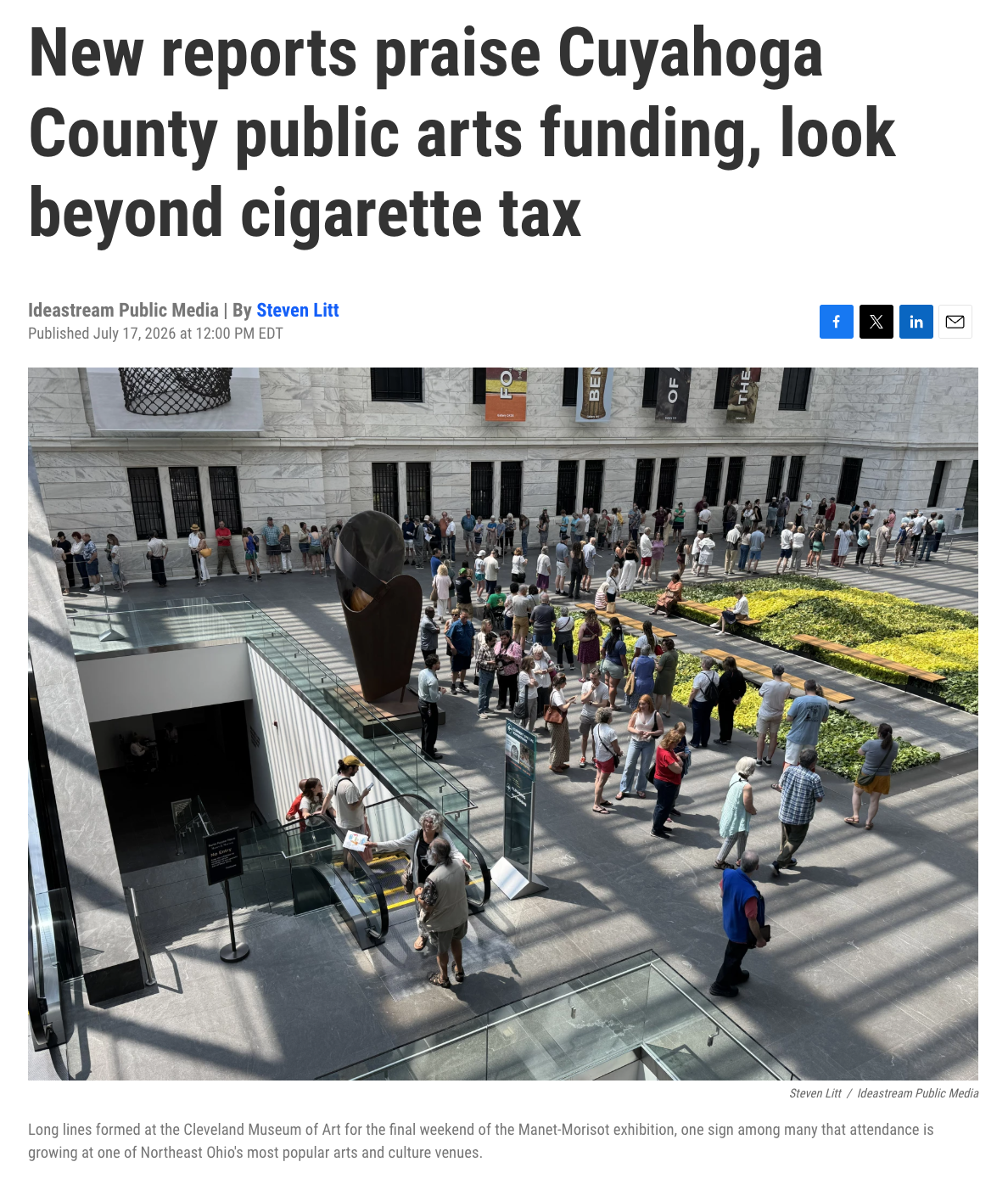
Ideastream: New reports praise Cuyahoga County public arts funding, look beyond cigarette tax
Stay Connected
Interested in future research, data insights, and conversations about arts and culture in Cuyahoga County?

Acknowledgements
This research was made possible through the generous support of the funders below who recognized the importance of this work for Cuyahoga County.

This research was commissioned by Assembly for the Arts and made completed through a partnership with SMU DataArts and Lord Cultural Resources.


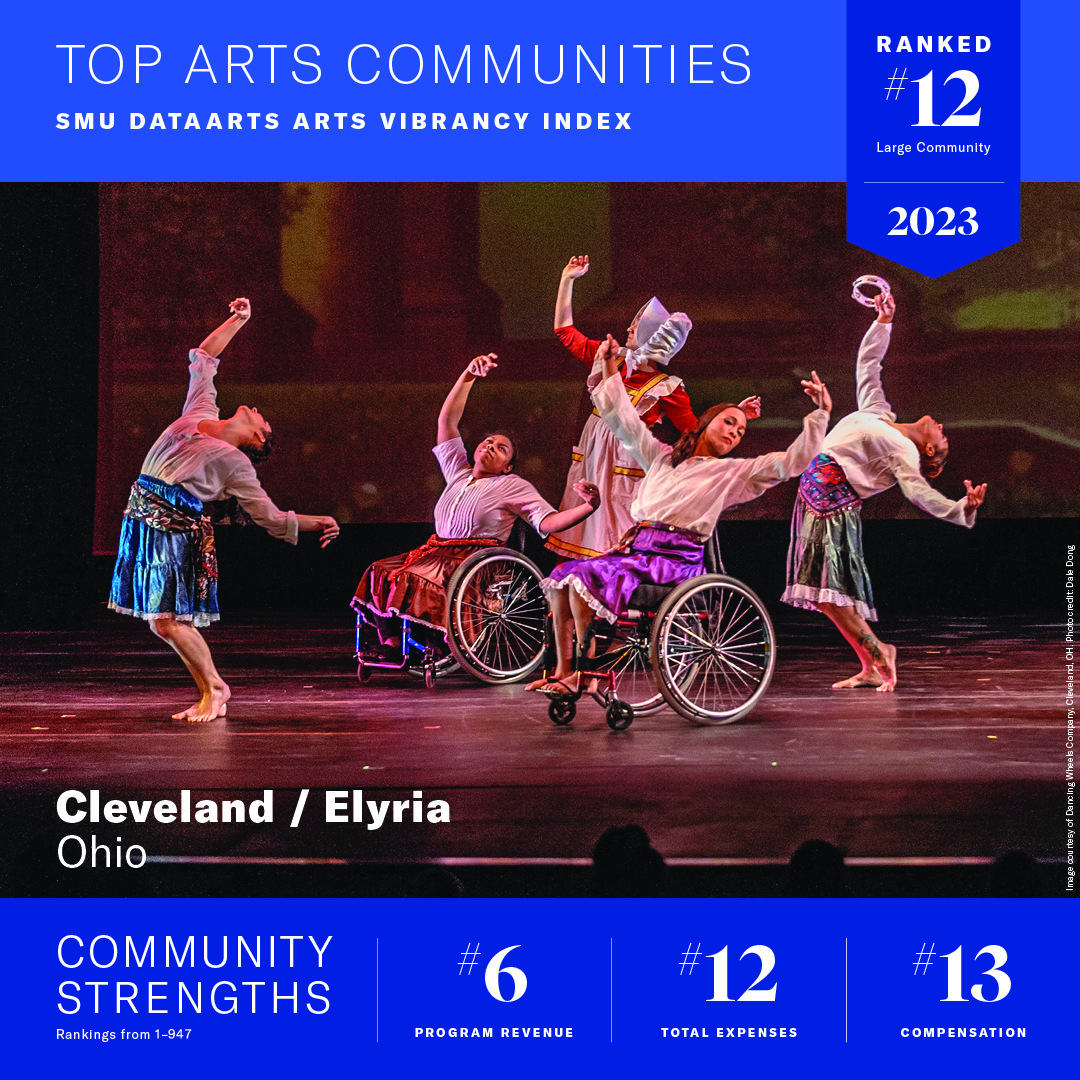
CLEVELAND-ELYRIA RANKED 12th AMONG 20 MOST ARTS-VIBRANT LARGE COMMUNITIES IN THE NATION
The 8th Annual Arts Vibrancy Index from SMU DataArts Compiles List of 40 Most Vibrant Arts Communities Across the U.S., Based on Measures of Per Capita Supply, Demand and Government Support for the Arts
CLEVELAND, OH, November 13, 2023 – SMU DataArts, the National Center for Arts Research, released its 8th Arts Vibrancy Index, which identifies Cleveland-Elyria as number 12 in the list of 20 large communities in the United States through an analysis of the level of supply, demand, and government support for the arts in more than 900 communities across the country. Organized into three separate lists based on community population size, totaling 40 communities across the country, this year’s Arts Vibrancy Index is the first to include numerical rankings since 2020, a reflection of arts organizations returning to in-person activities and performances following the easing of pandemic restrictions. Cleveland, along with neighboring Elyria, has consistently appeared on the Arts Vibrancy Index since its debut on the rankings in 2018.
This year, Cleveland is ranked 12th on the annual list of large communities in the nation -- the highest ranking it has ever achieved.
Related research by SMU DataArts shows that Local Arts Agencies (LAAs) like Assembly for the Arts and Cuyahoga Arts & Culture are powerful catalysts of arts vibrancy which ensure that the arts remain an integral part of community life. Fluctuations in a community’s ranking occur from year to year for a variety of reasons, including the opening of an arts district or closing of a performance space as well as local economic conditions.
Cuyahoga Arts & Culture (CAC) is the region’s largest funder for arts and culture. Since 2006, CAC has invested $230 million in over 470 organizations, including SMU Data Arts, to gather and share local nonprofit arts data through CAC’s grant application process.
“It’s important to have data to demonstrate the strength of Cuyahoga County’s creative community,” said Jill M. Paulsen, executive director of Cuyahoga Arts & Culture. “Each year, CAC-funded organizations contribute information to SMU DataArts to help us tell the story of the sector’s impact and shine a light on their work.”
Jeremy V. Johnson, CEO and president of Assembly for the Arts, said, “Cleveland is now ranked 12th in the nation in terms of Arts Providers, Arts Dollars, and Government Support, joining the company of arts-heavy cities such as New York City, San Francisco, Washington, D.C., and Philadelphia. The Arts Vibrancy Index demonstrates the arts’ enduring importance, resiliency, and vibrancy in Greater Cleveland, which is why it’s essential to maintain public support for this important part of our economy.”
Arts-vibrant communities can be found in every region of the United States—a finding which arises from an objective analysis of the data, and not from selecting communities by hand to achieve geographic representation.
“The arts and culture sector was hit hard by the pandemic, and some organizations and communities are still recovering. The Index is an opportunity for communities to affirm and celebrate the individuals and organizations that are the sources of arts vibrancy in their region, whether that’s artists who have mastered a local craft tradition over generations, a cultural festival that families enjoy year after year, or a cherished historic theater, museum, or arts-education center. For organizations, funders, local citizens, and public officials, the Arts Vibrancy Index is a powerful resource that leverages data-driven evidence to illuminate how the arts contribute to an area’s economy and public life,” stated Dr. Zannie Voss, Director of SMU DataArts. “One way that public leaders can spark arts vibrancy in their communities is by expanding funding for local arts agencies, which spurs arts employment, stimulates more artistic activity, and increases the strength of geographically dispersed arts-vibrant cultural resources throughout communities.”
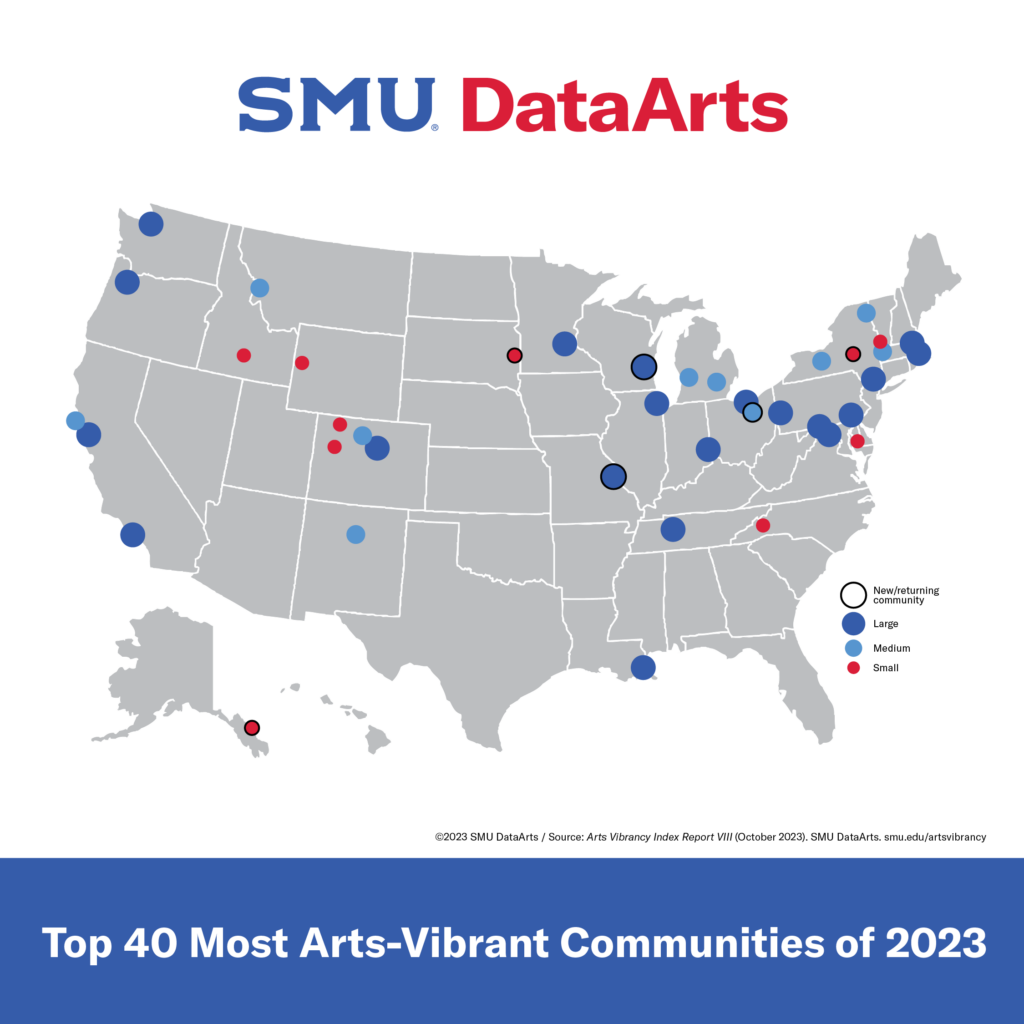
The Lists
In addition to the top arts-vibrant communities listed in the Arts Vibrancy Index, arts-vibrancy scores for every county in the United States can be viewed on an interactive map that identifies arts and cultural strengths that are present in every community. (Also known as Metropolitan or Micropolitan Statistical Areas, these communities have boundaries that are defined by the United States Census Bureau.)
Large Communities (population: 1 million +)
On the list of the most arts-vibrant communities with populations of 1 million or more, one city is new to the list: Milwaukee-Waukesha, WI. San Francisco-San Mateo-Redwood City, CA, sits at the top of the list for the first time since 2018 and Philadelphia, PA, has moved into the top 5 for the first time ever. After debuting in the 20th spot in 2020, Cincinnati, OH-KY-IN, has skyrocketed to the 11th spot.
- San Francisco-San Mateo-Redwood City, CA
- New York-Jersey City-White Plains, NY-NJ
- Washington-Arlington-Alexandria, DC-VA-MD-WV
- Boston, MA
- Philadelphia, PA
- Minneapolis-St. Paul-Bloomington, MN-WI
- Frederick-Gaithersburg-Rockville, MD
- Nashville-Davidson-Murfreesboro-Franklin, TN
- Los Angeles-Long Beach-Glendale, CA
- New Orleans-Metairie, LA
- Cincinnati, OH-KY-IN
- Cleveland-Elyria, OH
- Cambridge-Newton-Framingham, MA
- Denver-Aurora-Lakewood, CO
- Pittsburgh, PA
- Portland-Vancouver-Hillsboro, OR-WA
- Seattle-Bellevue-Kent, WA
- Milwaukee-Waukesha, WI
- Chicago-Naperville-Evanston, IL
- St. Louis, MO-IL
Medium Communities (population: 100,000 – 1 million)
Medium communities are home to populations ranging from 100,000 to 1 million people. Canton-Massillon, OH, is new to this list, while Santa Fe, NM; San Rafael, CA; and Pittsfield, MA, have appeared on the list of top medium communities every year since 2015. Ann Arbor and Kalamazoo-Portage, MI, are returning to this list following their 2022 debuts.
- Pittsfield, MA
- Santa Fe, NM
- Ithaca, NY
- San Rafael, CA
- Kalamazoo-Portage, MI
- Boulder, CO
- Missoula, MT
- Canton-Massillon, OH
- Burlington-South Burlington, VT
- Ann Arbor, MI
Small Communities (population <100,000)
Small communities are defined as areas with populations under 100,000. Jackson, WY-ID, and Bennington, VT, have made the list of small communities every year since 2015, with Jackson maintaining its ranking as first among small communities for the past four years.
- Jackson, WY-ID
- Brevard, NC
- Steamboat Springs, CO
- Bennington, VT
- Easton, MD
- Glenwood Springs, CO
- Hailey, ID
- Juneau, AK
- Brookings, SD
- Oneonta, NY
The overall Arts Vibrancy Index is composed of 13 unique measures which cover aspects of supply, demand, and public support for arts and culture, and are adjusted for cost of living and population differences among communities. In this year’s index, the analysis approach was updated to weight the 13 inputs based on their relative explanatory power for the underlying concept of arts vibrancy. This approach improves measurement consistency in the face of data availability delays or other changes in individual datasets from year to year. All financial metrics have been adjusted for cost of living in order to level the playing field. The cost of doing business varies based on local conditions, so the same dollar goes further in some communities than others.
ABOUT ASSEMBLY FOR THE ARTS
Assembly for the Arts is a 501(c)3 nonprofit organization with a focus on advocacy, cultural policy, racial equity initiatives, research, marketing that elevates the region, and services for nonprofits, artists, and creative businesses. It is governed by a volunteer board with a strong commitment to diversity and inclusion. Assembly by design operates in close partnership with Cuyahoga Arts & Culture, a government agency, and Assembly for Action, a 501(c)4 political action nonprofit to serve the entire creative sector. Assembly is supported through major funding from: The Cleveland Foundation, The George Gund Foundation, The Char and Chuck Fowler Family Foundation, Cuyahoga Arts & Culture, Ohio Arts Council, Huntington, KeyBank, The George W. Codrington Charitable Foundation, and Fred & Laura Ruth Bidwell. www.assemblycle.org
ABOUT CUYAHOGA ARTS & CULTURE
Cuyahoga Arts & Culture (CAC) is the region’s largest funder for arts and culture, helping hundreds of organizations in Cuyahoga County connect millions of people to cultural experiences each year. Since 2006, CAC has invested $230 million in over 470 organizations, making our community a more vibrant place to live, work and play. CAC is a separate government entity and a political subdivision of the State of Ohio. For more information, visit cacgrants.org.
ABOUT SMU DATAARTS
SMU DataArts, the National Center for Arts Research, is a project of the Meadows School of the Arts at Southern Methodist University. The mission of SMU DataArts is to provide and engage both organizations and individuals with the evidence-based insights needed to collectively build strong, vibrant, and equitable arts communities. Its research efforts range from academic papers published in leading journals, applied research undertaken with community partners, and actionable insights shared directly with arts practitioners. Its programs provide business intelligence tools and resources to help arts leaders leverage data to answer critical management questions and connect research analyses to their own work. Recent publications include research reports on emergence from the COVID-19 crisis; the alchemy that drives high performing arts organizations of color; audience diversity, equity and inclusion in large performing arts organizations; impact of investments made in diverse creative communities; and more.
###
Media Contacts:
Malissa Bodmann
216-536-7517
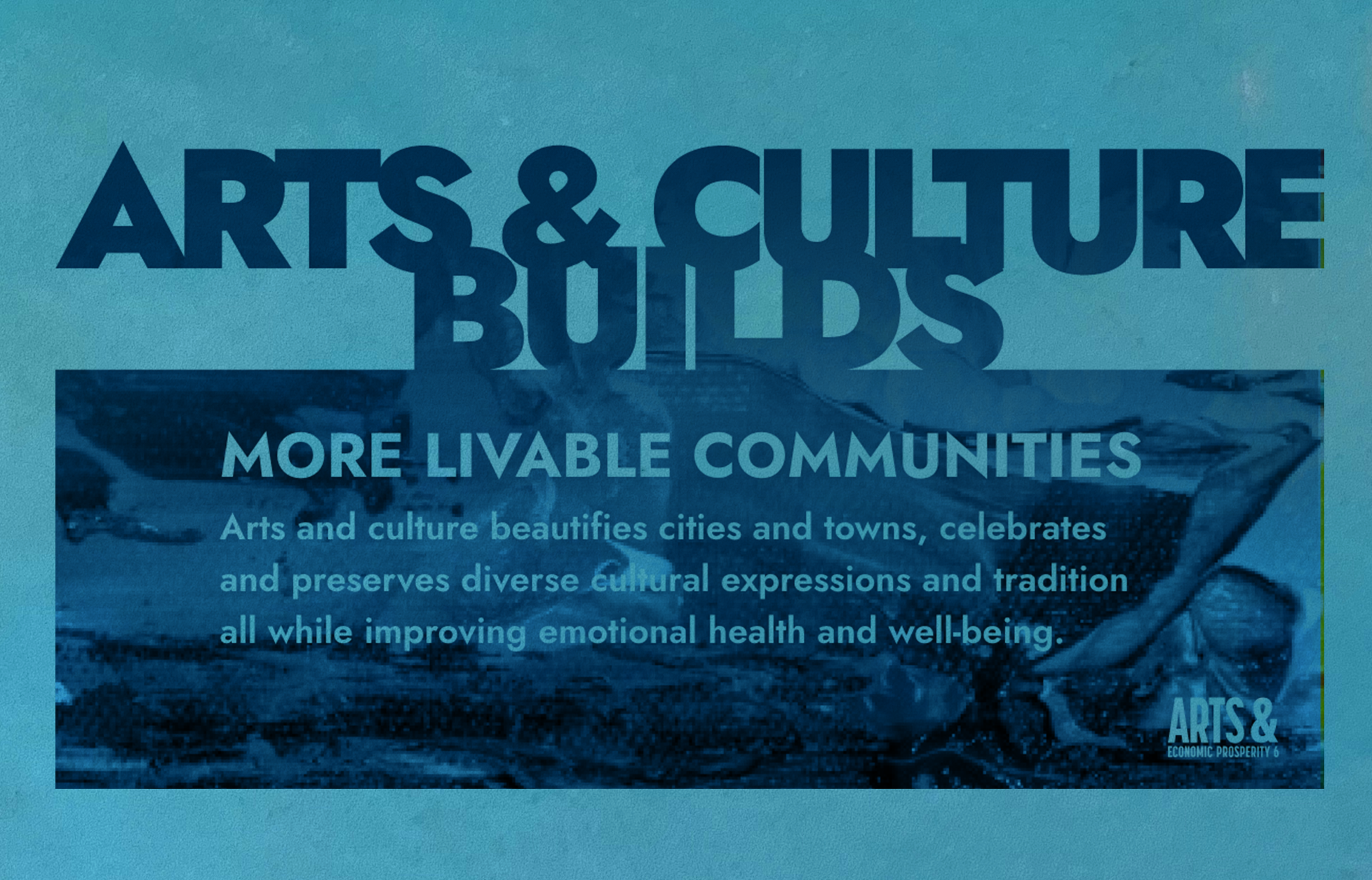
Arts and Economic Prosperity 6 Report
Cuyahoga County’s nonprofit arts and culture industry generated $533,156,171 in economic activity in 2022, according to the newly released Arts & Economic Prosperity 6 (AEP6), an economic and social impact study conducted by Americans for the Arts. That economic activity — $389.8 million in spending by nonprofit arts and culture organizations and an additional $143.3 million in event-related spending by their audiences supported 8,637 jobs and generated $104.2 million in local, state, and federal government revenue. Spending by arts and culture audiences generates valuable commerce to local merchants, a value-add that few other industries can compete with.
Building on its 30-year legacy as the largest and most inclusive study of its kind, AEP6 uses a rigorous methodology to document the economic and social contributions of the nation’s nonprofit arts and culture industry. The study demonstrates locally as well as nationally, arts and culture are a critical economic driver of vibrant communities. In Cuyahoga County, more than 1,100 audience members participated in the survey and 172 nonprofit organizations supplied financial and audience information – about 38% of nonprofit arts and culture organizations in the county. The study also surveyed audiences of color for the first time ever.

Support for Artists Campaign Findings
Outcomes of the Support Artists Campaign
Assembly is excited to receive a $500,000 grant from Cuyahoga Arts & Culture to administer support for artists programs in 2024. This is a 25% increase in CAC funding over last year.
Chosen as the sole grantee for CAC’s Support for Artists funds, Assembly will run an artist support grant program in 2024 in addition to regranting funds to Cleveland Public Theatre, Julia de Burgos, Karamu House and SPACES to continue their successful work with artists who have been previously funded by grants from CAC. Assembly will work to ensure artists of multiple disciplines are represented, including musicians.
More information will be shared in the first quarter of 2024.
Assembly will structure the 2024 programs in response to feedback from Greater Cleveland’s artist community through four listening sessions and online surveys conducted August to September, 2023. Assembly engaged Dr. Brea Heidelberg of ISO Arts Consulting to facilitate these discussions to generate community feedback and recommendations to inform future programs and services. The research was funded by Cuyahoga Arts & Culture and The George Gund Foundation.
The key learnings from the listening sessions and survey that will guide our work in 2024 and beyond are:
- Prioritize unrestricted funds and increase and the amount awarded to each artist
- Increase overall support for artist funding by seeking sources beyond Cuyahoga Arts & Culture
- Create a central virtual space for finding grant opportunities, deadlines, and resources to help artists navigate and utilize the funding ecosystem
- Simplify and streamline grant application processes to reduce administrative burdens.
- Prioritize funding and resources for historically underrepresented or marginalized artists
- Increase opportunities for artists to be included in discussions on conversations about civic and social issues by facilitating connections between artists and civic leaders.
- Facilitate more artist listening sessions
- Establish an Artist Advisory Board that:
-
- Has diverse geographic representation from the City of Cleveland and Cuyahoga County
- Is comprised of artists representing a wide variety of arts disciplines
- Has term limits that allow for a regular rotation of artist advisors
- Is compensated for their time and expertise
- Advises Assembly for the Arts on their programs and policies
Working Together as One Community
Assembly and CAC acknowledge restorative work in the artist community will be foundational to the success of our future efforts. We look forward to working together and with all of you in the arts community to heal harms of the past, expand the pie of resources to our vitally important creative sector, and create a robust artist funding mechanism that includes sustained funding from private and public resources.
Past Programs
Assembly recognizes that the healthiest mix of artist support comes from a variety of sources. Previous artist support programs through Assembly have included:
- ARPA Rescue Funds $1.65 million to artists and creative for-profit businesses through American Rescue Plan Act funds from Cuyahoga County.
- Arts Leadership Residency in partnership with Cleveland Leadership Center and Huntington’s Entrepreneur in Residence program. 25 artists received $1,000 each and 6 learning sessions to help them grow their creative businesses.
- 2023 Creative Impact Fund 16 artists, collectives and informal groups received $6,250 each for flexible (unrestricted) funding and project-based placemaking in redlined communities that lack arts investment. Funded by a grant from Cuyahoga Arts & Culture.
Other Resources for Artists
Visit our Business of Art section for tools to help you make your creative endeavors a sustainable venture.
Looking for a Fiscal Sponsor? Skip the process of becoming a nonprofit organization in order to access grant funds by having Assembly become your fiscal sponsor. Not all community projects or artists can afford to or need to become their own nonprofit. The process of becoming a nonprofit requires time and resources that could otherwise devoted to the project itself. Assembly can help by acting as your fiscal sponsor
Sign up for Assembly’s newsletter to stay informed of upcoming workshops, community meetings and funding opportunities.
Check out and use clevelandartsevents.com. So much more than just events, this is a central website to create and find artist profiles, events, venues, and opportunities (jobs, grants, fellowships, artist calls). Create a free account today to join the monthly email list.
Still have questions? Email us at info@assemblycle.org.

This effort is made possible by generous support from the George Gund Foundation and Cuyahoga Arts & Culture.
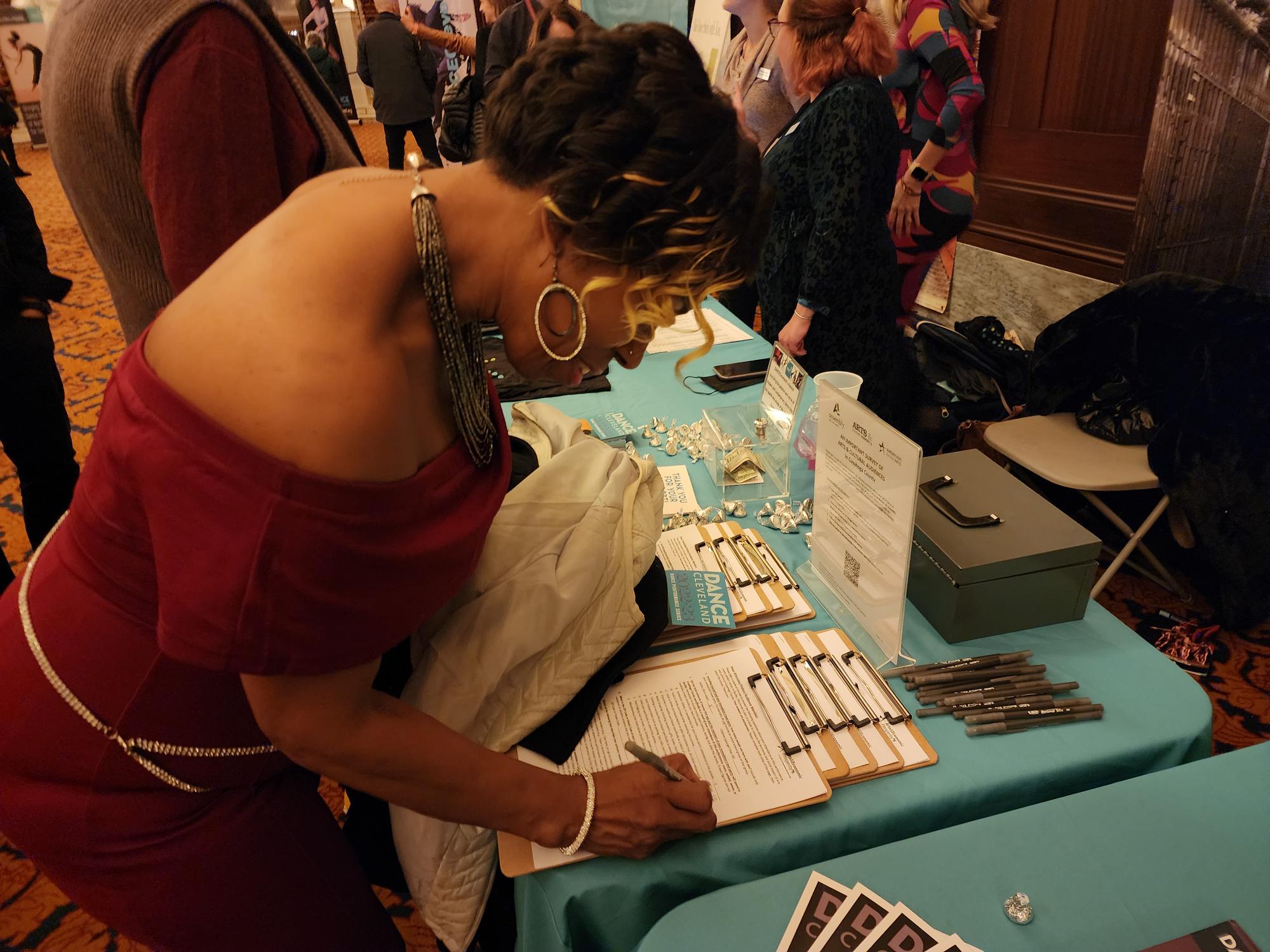
Arts & Economic Prosperity 6
Change the Conversation About the Arts
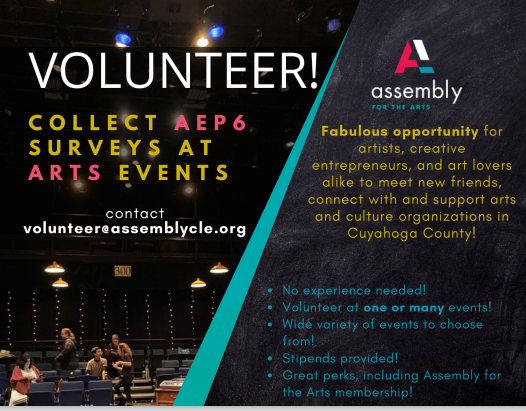 Becoming an AEP6 Volunteer with Assembly is a great way to meet new people, show your support for our arts communities and get some great perks!
Volunteers will help with survey prep and on-site survey collection at arts and culture events of all kinds. You’ll also get to:
- Talk with other arts-minded people
- Advocate for the arts
- Help others learn about Assembly for the Arts programs
- Expand your network
Email volunteer@assemblycle.org to sign up and learn more!
What is the study?
Assembly is excited to partner with Americans for the Arts on Arts & Economic Prosperity 6 (AEP6).
AEP6 is an economic impact study of the nation’s nonprofit arts and culture industry. It’s the largest and most inclusive study of its kind ever conducted, with a specific focus on 387 participating communities from across the country.
For the first time ever, this study includes Cuyahoga County as part of the more than two hundred regions surveyed nationwide. View the Press Release.
Nonprofit Partners
Assembly is working with nonprofit organization partners to survey their audiences at arts and culture events of all kinds across the county. These surveys will provide important information on how much people are spending at arts events, what neighborhoods are participating and their investment in and connection to the arts.
Why is This a big deal for Cuyahoga County?
In short, Economic impact studies like AEP6:
- Can help organizations like Assembly advocate for more resources for arts and culture, including future funding
- Illustrate the major economic impact of the arts in our region
- Influence where tax dollars are invested
- Help change how people view arts and culture
Download 10 Reasons to Support the Arts in Cleveland.
Download 10 Reasons to Support the Arts in Cuyahoga County.
Thank You
To our friends that have partnered with us on this!
Beck Center for the Arts
CAN Journal
Cleveland Institute of Art
Cleveland Institute of Music
Cleveland Museum of Art
Cleveland Play House
Cleveland Public Theatre
Dance Cleveland
Dancing Wheels
Djapo Cultural Arts Institute
Dobama Theatre
Future Ink Graphics (FIG)
Great Lakes African American Writer’s Conference
Greater Cleveland Urban Film Festival (GCUFF)
Julia De Burgos Cultural Arts Center
Kaiser Gallery
Karamu House
Les Delices
Museum of Contemporary Art Cleveland (moCa)
Museum of Creative Human Art
Musical Theatre Project
Near West Theatre
Oh Sew Powerful
RidAll Green Partnership
The Cleveland International Film Festival
The Cleveland Orchestra
The International Women’s Air and Space Museum
The Maltz Museum of Jewish Heritage
The Rock N Roll Hall of Fame
ThirdSpace Action Lab
Twelve Literary Arts
Western Reserve Historical Society
Get Involved and Become a Partner
AEP6 in Cuyahoga County, can’t be successful without you. Help Assembly reach our goal of 800 surveys for Cuyahoga County and Sign up to become an organizational partner today. This year QR codes make it even easier to distribute. They have also translated the audience survey into 24 languages! Even surveying ONE of your events makes a difference!
Watch the Webinar to learn more about AEP6 and what you need to know as a partner.
Local & State Advocacy
Championing Public Investment in the Creative Sector:
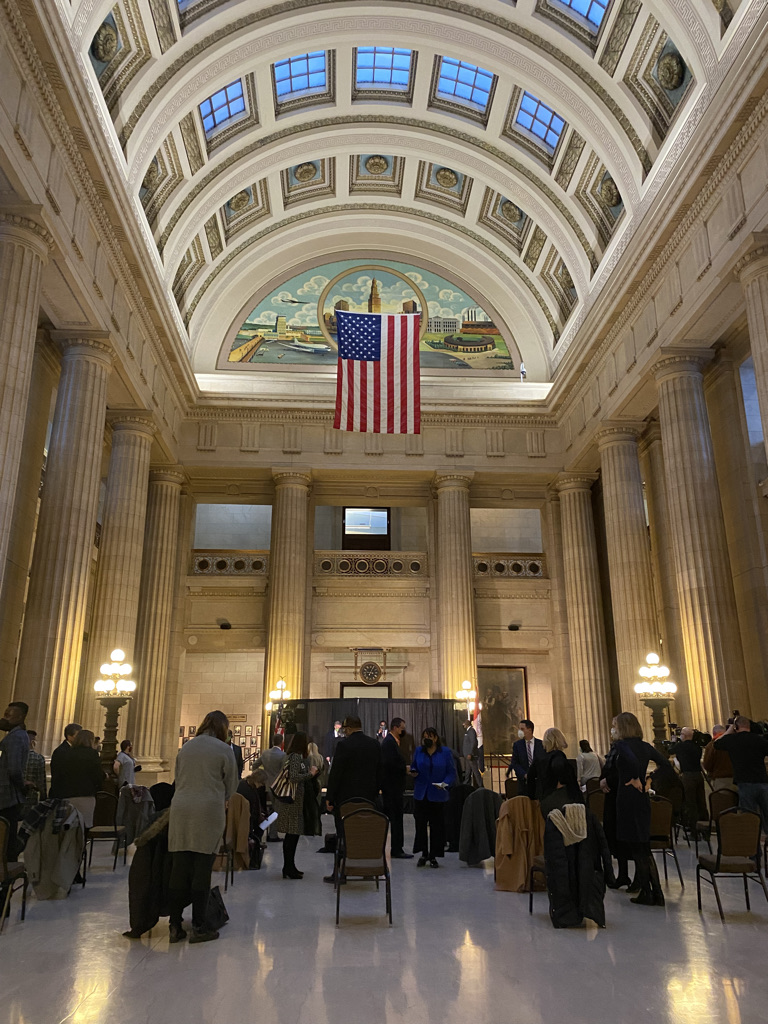
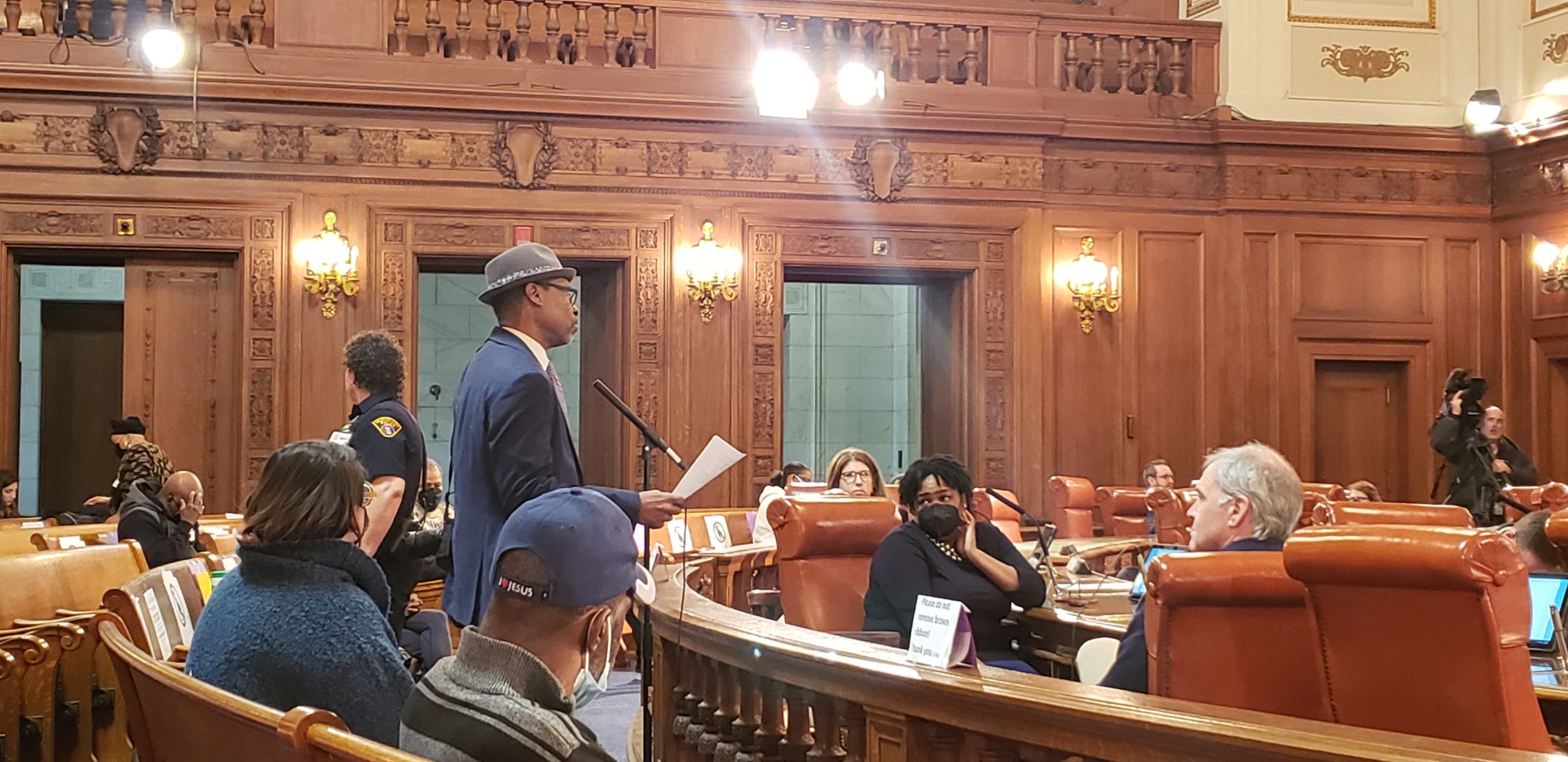
Our first year of work coincided with one of the worst economic periods for the region’s creative sector because of the COVID-19 pandemic. Assembly mobilized community partners to plead the case for American Rescue Plan Act funds with Cuyahoga County and City of Cleveland government.
Thanks to the advocacy of the Assembly board and the partnership of Cuyahoga Arts & Culture (CAC), Cuyahoga County Executive Armond Budish and Cuyahoga County Council President Pernel Jones jointly committed to $3.3M in ARPA funds for arts and culture. Approved by Council in July 2022, Assembly and CAC will split the $3.3 million equally and will establish processes to equitably distribute the funds to the for-profit and non-profit creative economy and artists.
During 2021’s Cleveland Mayoral Election, Assembly engaged with candidates to ensure arts and culture was represented in public debates. Assembly also partnered with CAN Journal to launch a candidate survey on their policy vision for arts and culture.
When Cleveland Mayor Justin Bibb took office in January 2022, Assembly set out to build relationships with the new mayor and his administration to elevate arts and culture in the public agenda. In the Fall of 2021, Assembly held multiple forums with artist coalitions, creative businesses, and nonprofits to develop a set of arts-informed recommendations for the new administration. One of our many recommendations was to establish an arts liaison at City Hall to drive a strategic cultural agenda. The Mayor’s Chief Strategy Officer Bradford Davy confirmed that an appointment of an arts leader/liaison will be forthcoming.
Data are vital to demonstrate the creative sector’s impact when we speak with public officials. We partnered with Ohio Citizens for the Arts (OCA) and Cuyahoga Arts & Culture, along with six other regional arts councils, and Bowling Green State University’s Center for Regional Development on a study about the Cleveland creative industry’s economic contribution.
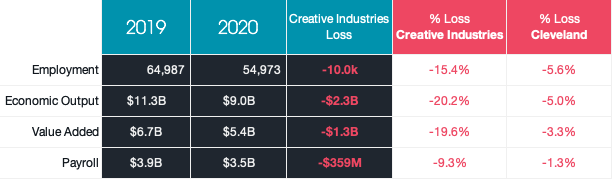
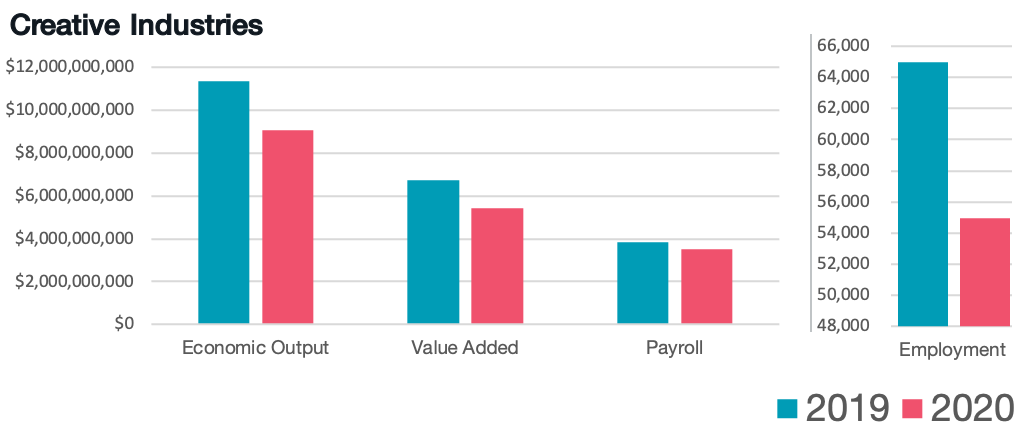
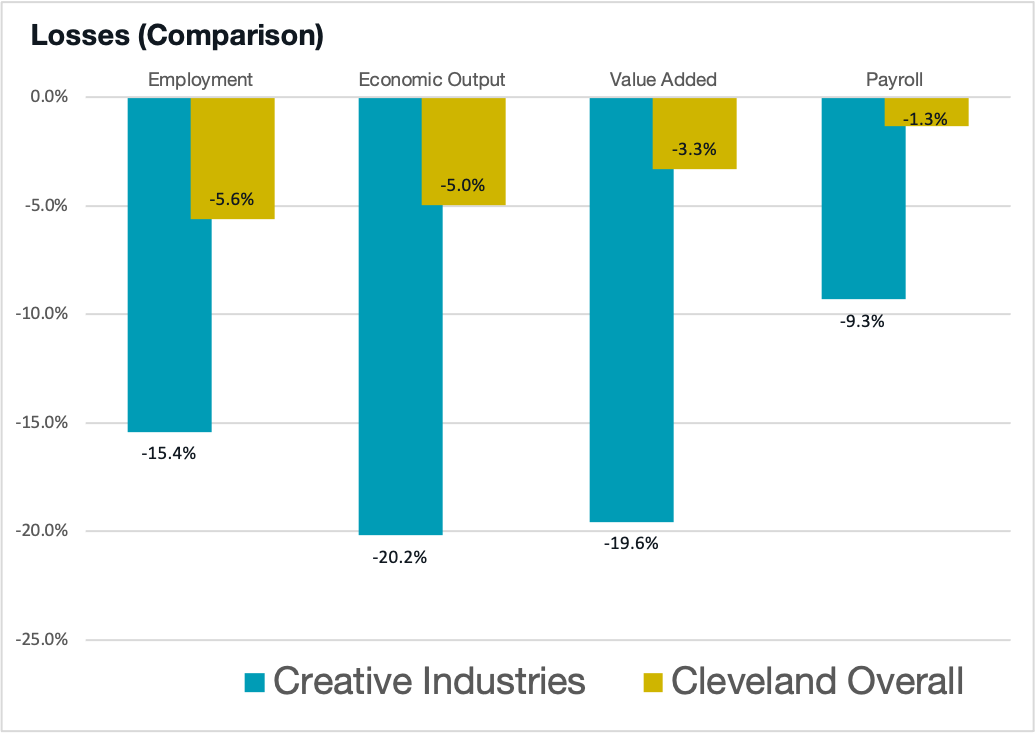
The results were sobering and clear: the creative sector in Cleveland is an economic powerhouse, which generated more than $6.7 billion in economic output in 2019 – and the COVID-19 pandemic decimated the industry, which has yet to rebound.
REVS Cleveland / Akron
Reopen Every Venue Safely – Cleveland Akron
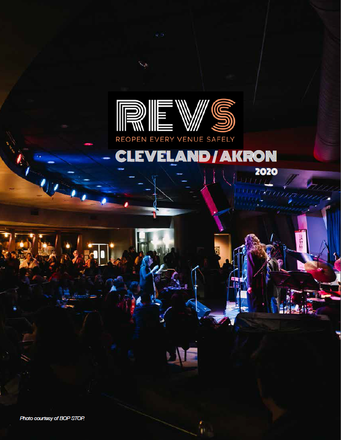
Guidelines and best practices for live music venues in Cleveland/Akron as part of the national Reopen Every Venue Safely (REVS) campaign.

With COVID-19 came the shutdown of many businesses. While most places reopened late spring/early summer, live music venues remained closed. In the midst of COVID-19, live music venues have often been called the first to close and the last to open due to the many concerns around the safety of live music. To work towards reopening local live music venues safely, in May, Cleveland/Akron got involved in the Reopen Every Every Venue Safely (REVS) initiative launched by Music Cities Together. This initiative is focused on helping venues open as safely and as soon as possible by providing best practices and guidelines. The best practices and guidelines you will read below were built from meetings and discussions between Arts Cleveland and local music venue owners and directors, musicians, and public health professionals.
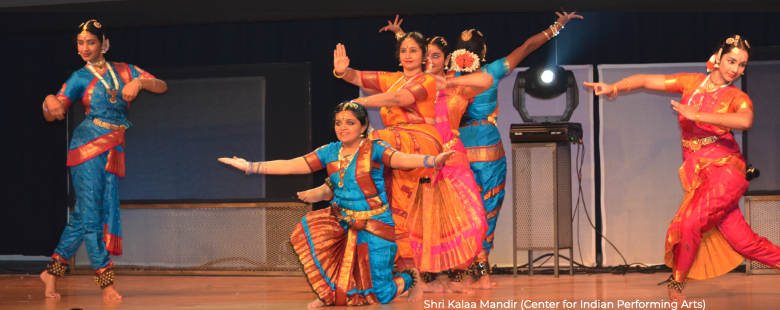
Data Brief - Dance in Cleveland
Dance In CLE

Cleveland’s dance industry, including both creative and non-creative jobs increased to 302 jobs in 2015. The industry analysis is made up of dance companies and promoters as well as fine arts schools.