
Public Arts and Culture Investment Models. 2004.
Cuyahoga County Cultural Leadership Taskforce Report to Cuyahoga County Board of Commissioners
This report details findings and recommendations of the Cuyahoga County Cultural Leadership Taskforce. This team was convened by Cuyahoga County’s Board of Commissioners to develop a system for the distribution of local public sector funds for arts and culture.

Arts and Cultural Industry Workforce Barometer - 2004
A Survey of Northeast Ohio Nonprofit Arts and Cultural Organizations

This report summarizes Arts Cleveland’s second survey of job loss and growth in the arts and cultural sector. The survey’s goal was to understand the health of Northeast Ohio’s nonprofit arts and cultural assets. This survey was expanded to include Cuyahoga, Geauga, Lake, Lorain, Medina, Portage and Summit Counties.
Economic Impact of Non-Local Arts and Culture Consumers

This study examines the economic impact of 9 Cuyahoga County-based arts and culture organizations with different budget sizes and disciplines. The report is intended to improve regional understanding of the economic impact of arts and culture visitors to Cuyahoga County.
Arts & Culture Organizations: A Study of Their Occupations
Arts & Culture Organizations: A Study of Their Occupations
Advancing Support Systems for Artists in the Cleveland Metro Area
Artists, whether they are visual, performing, literary or media, are a stimulating force in communities across the U.S.
They are typically the entrepreneurs of the arts and cultural sector. They ask probing questions, take risks and develop new concepts that can be fostered and built upon in both the non-profit and for-profit arenas. Artists penetrate all parts of society, from the neighborhood level to the commercial level. They engage residents in discourse through performances and instill pride through the development of community reflective murals. They influence the design of our everyday wares and develop challenging creative works such as dances, films, novels and paintings
Artists, however, are not always well understood by the communities they inhabit. A lack of information about their needs and contributions has resulted in less than adequate systems to support their diverse efforts. To address this topic, a national consortium of foundations commissioned The Urban Institute in 1999 to conduct a study of the systems and structures that support the work of individual artists. Released in 2003, Investing in Creativity: A Survey of the Support Structure for U.S. Artists spawned a nationwide effort (led by Leveraging Investments in Creativity) to dramatically improve conditions for individual artists.
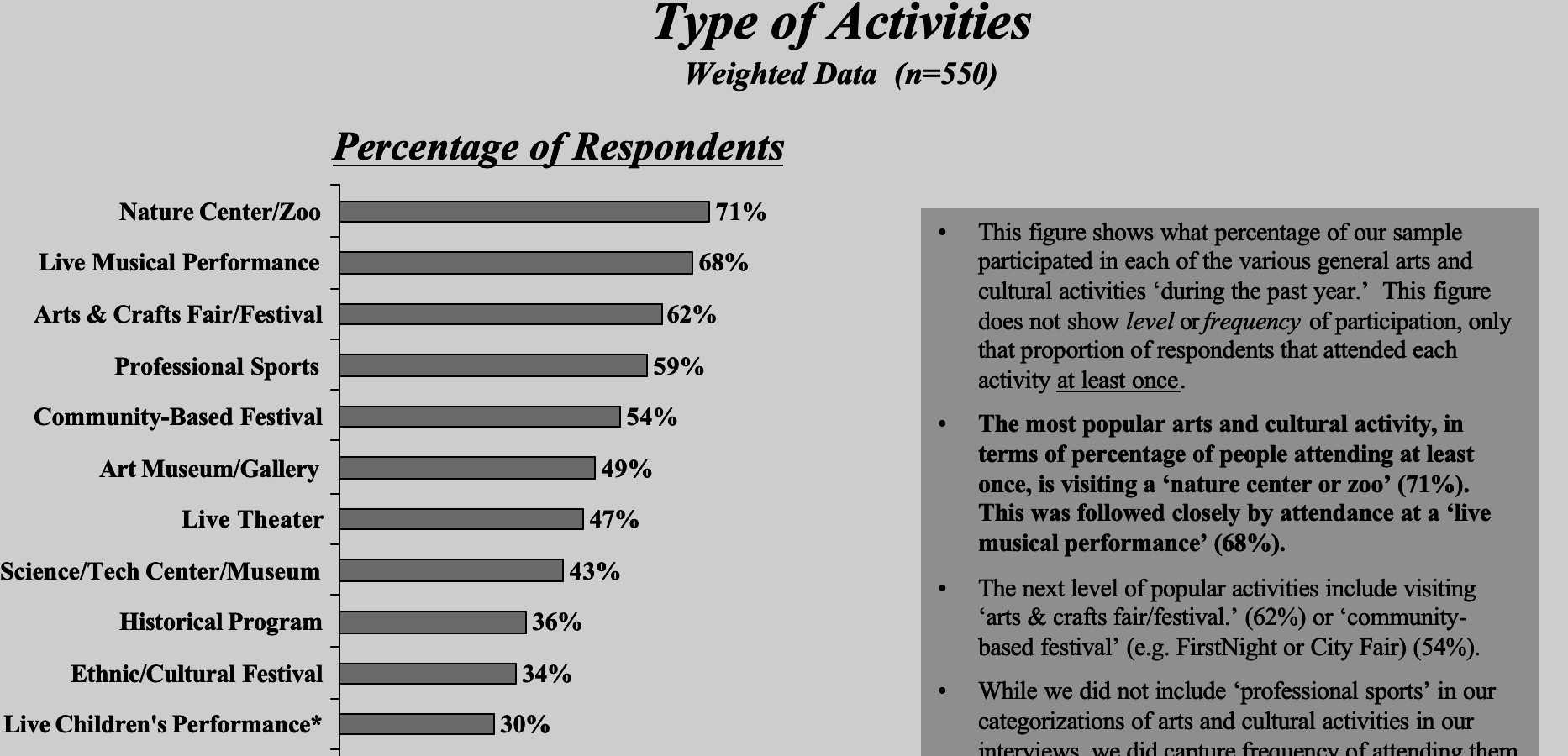
Arts and Culture Participation (Akron) – Benefits and Barriers 2002

A Survey of Arts and Culture Consumers in Greater Akron
This study outlines what drives consumers to participate in arts and culture activities in Greater Akron as well as what prevents them from doing so. It is intended to aid in the development of programming and marketing concepts for arts and culture organizations in Greater Akron.
Cleveland City Council Arts and Cultural Summit Report. 2002.
This report highlights the findings of the Cleveland Arts and Cultural Summit, a community discussion by Cleveland City Council. The report covers recommended action items designed during the summit to help sustain the regional arts and cultural industry.
Arts and Culture Participation - Benefits and Barriers 2002
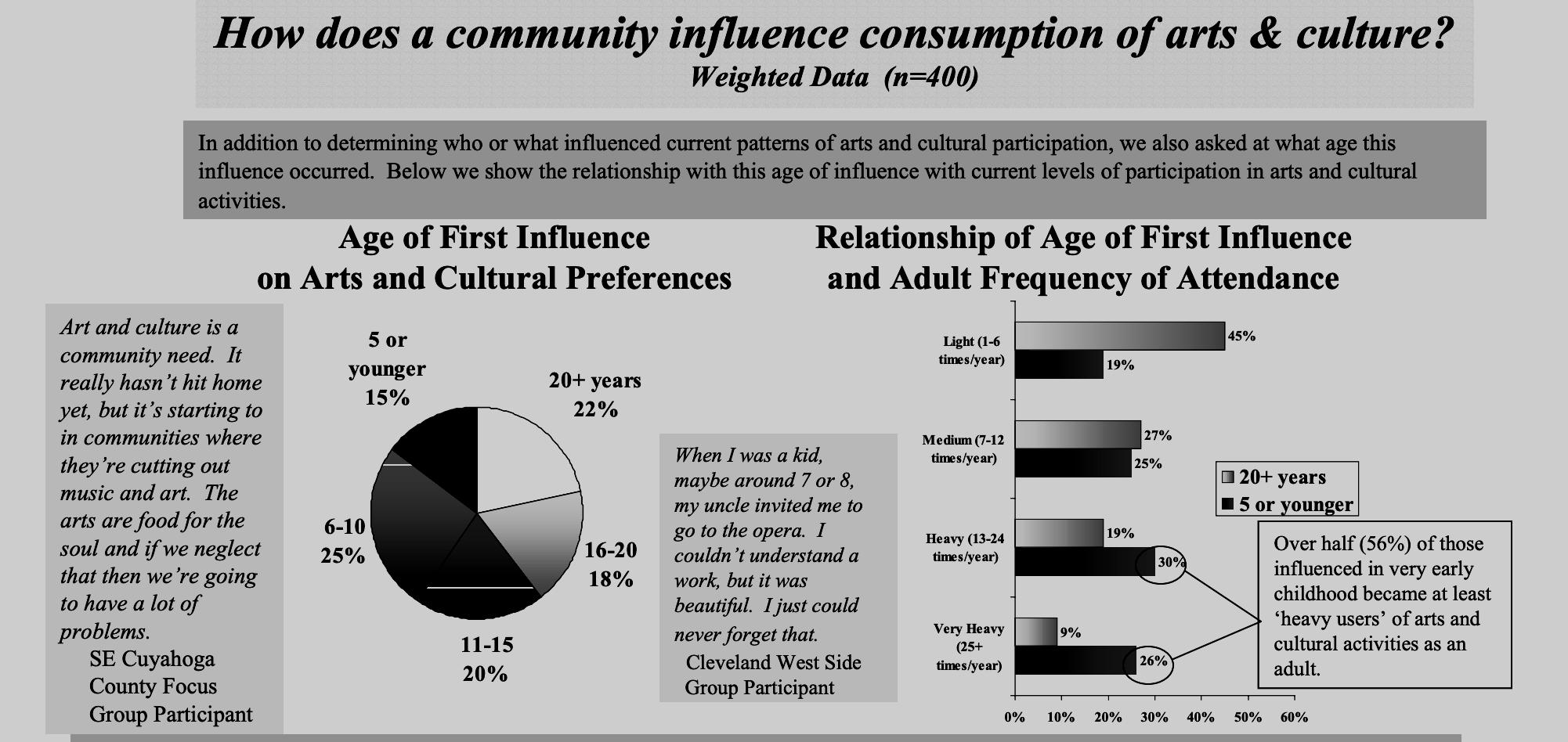
A Survey of Arts and Culture Consumers in Northeast Ohio: Arts and Culture Participation – Benefits and Barriers. 2002.
Eight focus groups and a telephone survey of 800 adults were conducted from July, 2001 to November, 2001. Participants in the study were only those who have participated in at least one arts and cultural activity or event during the past year. The objectives of this study were to 1) identify the major benefits of arts and cultural participation in NE Ohio, 2) identify the major barriers and motivators for arts and cultural participation. This information was intended to aide in the formulation of programming and marketing concepts for arts and cultural organizations in NE Ohio.